2026
A producer must spend less, produce and sell more. However, at the end of the season it happens that the balance is often not positive, but with a minus sign. So what will make it possible to diversify production and reduce risks?
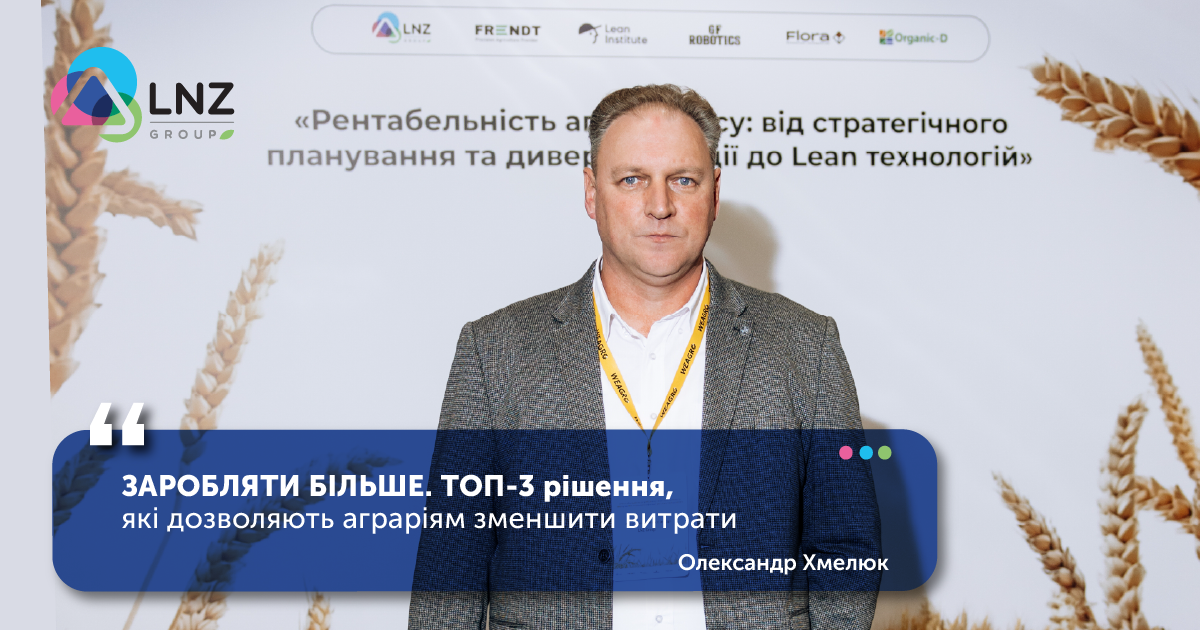 The head of the Agro Department of LNZ Group, Oleksandr Khmeliuk, during the agro-meeting by the Weagro service and Activitis Education "Agribusiness profitability: from strategic planning and diversification to Lean technologies", named trend solutions that farmers should implement for efficient production in the future.
In agriculture, compared with other industries, the turnover of funds is very low. For example, winter wheat is sown and money begins to be invested in autumn, in winter it is spent on fertiliser and crop protection products, and the harvest is gathered in July, and then it is sold. That is, only after a year of work will the farmer in fact be able to assess their financial result, and it will depend on what the price for the produce will be and whether the harvest will be high. These are events that will happen in the future, which need to be forecast. However, we cannot influence absolutely everything.
"Those excessive costs that farmers do not incur today are precisely their earned money in July-August, when they harvest and sell their crop. That is, producers must constantly control the costs of growing crops."
Field zoning. Often fields differ even within one farm or locality. At the basis of the differences are the relief and soil type, its fertility. There are fields with greater yield potential, and there are the opposite. Rational from the point of view of costs and yield potential is an individual approach and a different need for applying fertilisers or crop protection products. And, conversely, applying them at a single rate on all fields of a particular crop will be inexpedient.
There is no single correct solution, for example, based on NDVI index maps, with the help of which fields can be zoned and worked accordingly. Today the most rational is yield mapping. After all, yield is the outcome, the result of the action and interaction of all factors. Such data must be accumulated year after year in order to single out productivity zones, because different crops react differently to one or another background, to one or another conditions. Accordingly, with each year the zoning will become more accurate.
"Let us imagine some field and a notional standard technological map, but there will be zones with higher productivity and vice versa. On one part of the field we will incur excessive costs that may not pay off and will definitely reduce profitability. And, conversely, there will be zones with high potential that we do not realise and, accordingly, do not get the possible profit from them. It is precisely such high-potential zones that need more attention, because the yield potential there will be greater, and it makes sense to invest more there," notes the expert.
In zones with weak productivity, first of all one should reduce the level of costs to their potential, so that even a low harvest is profitable, and investigate the reasons for the zone's low productivity. If possible, it needs to be improved, but the payback of such investments over the term of the land lease agreement should be taken into account.
"This is also one of the big problems, when the farmer always works within the term of the lease agreement, and then making plans 5-20 years ahead and investing for such a period is risky. So such a zone simply has to be low-productivity, but bring profit."
Crop rotation — one of the important components of an effective agribusiness strategy. The larger the farm size, the more it usually has a structure of sown areas developed for at least 5 years. There is a more or less clear understanding of which crops occupy which percentage. Small ones, as a rule, do not have such plans, often make emotional decisions shortly before the sowing campaign. The assessment of growing any crop should be made in the context of the crop rotation, not in the context of some one year. Since this has a significant impact on the crop's productivity potential and the growing technology as a whole, in particular the tillage system, the nutrition system, the protection system, etc. In this case the productivity and economic efficiency of growing crops will change, may differ significantly.
"Crop rotation must be developed for at least 3-5 years or one rotation. Accordingly, from the crop rotation and the region's conditions the direction or vector will be set, according to which technology we will work, for example, in tillage. Changing the technology is not so simple — it is considerable investment," explains the specialist.
For a crop more sensitive to tillage, for example corn, deep loosening can be carried out. Yes, it is worth spending money on this, but the effect of this technique will also have an impact on the next crop. For example, on soybean after corn, then minimum tillage can be done, or loosening can be carried out for sunflower, and then wheat sown with minimum tillage or without it.
That is, having a crop rotation at the basis, which is a strategy for 3-5 years, an optimal tillage system can be developed that will save the enterprise's funds and at the same time ensure the crops' productivity potential.
The use of crop protection products. The "apply and pull out" scheme does not work. At a certain stage of the plant's growth and development, corresponding processes take place. They are irreversible. If wheat has passed into the stem-elongation phase, it will never return to tillering, no matter how conditions develop. One needs to understand what plant organogenesis is, when and at what stage the organ-forming processes take place in the crop, thanks to which the harvest is formed.
The growing season of any crop can be divided into three large stages.
- On the example of winter wheat, the stage up to the end of the tillering phase is the formation of the "foundation". At this stage of organogenesis, during the vegetative development phase up to the moment when the plant passes to the formation of generative organs, the laying of the "foundation" takes place, the stand is formed — the main element of the yield structure. Often this stage of the crop's development is underestimated, weed control is not always carried out or herbicides are applied later. But in this period the "foundation" is destroyed, and, accordingly, the subsequent stages will already be less productive.
- The second stage — the formation of the "framework", i.e. when the plant's generative organs are formed quantitatively (from the laying of the flower elements to pollination/fertilisation), which in the future will form the harvest.
- The last stage — production itself. This is the period after pollination, fertilisation, when the grain, the harvest, is formed. High potential can only be laid at the early stages. Further it just needs to be maintained.
"On corn, they often try to pull out the harvest at the expense of the thousand-seed weight. But this indicator in the yield structure has the least impact on yield. Of greater importance will be the population size, i.e. the number of plants. As for sunflower, soybean and rapeseed — on the contrary, it is precisely the thousand-seed weight that will affect yield to a greater extent. So, to obtain high and stable harvests, one needs to clearly understand the yield structure, under what conditions the organogenesis stages take place and at the expense of what we should obtain our harvest. In fact, this will determine the structure of sown areas, the possibility and expediency of growing one or another crop."
If the crop's emergence is uneven, then during the growing season a weak plant will never be able to catch up with a strong one. This difference will only intensify. One of the goals of getting a good harvest should be the uniformity of emergence of any crop. The more uniform the emergence, the more uniform the crops' development and the greater the productivity potential, the easier the decision-making on carrying out one or another agronomic measure. For example, sunflower is relatively difficult to grow in terms of weed control. On the one hand, the set of active ingredients is not that large, and on the other — there are clearer frameworks by the sunflower development phases when one or another herbicide can be applied. This ultimately affects the final result.
"Crop care in Ukraine generally comes down to the protection system, sometimes feeding mainly with nitrogen fertilisers and/or complex ones foliarly. Weed control should be finished by the end of the vegetative development phase of the plants. This is the period when the crops will be least sensitive to the phytotoxic effect of herbicides. Even if there are some herbicide active ingredients that can be applied later — when the plants have passed to the generative development period, but this should already be an exception to the rule, a special case or an extreme necessity," Oleksandr Khmeliuk explains.
He adds that herbicide application should be completed:
- for cereals — by the end of tillering; for sunflower, depending on the maturity group — in the phase up to eight leaves (most hybrids) or up to ten leaves for late maturity groups;
- on corn, herbicide application must be finished by the five-leaf phase (V5);
- fungicide treatment should be carried out depending on the crop type and growing zone, i.e. the risks characteristic of the given zone.
- As a rule, the first application will be of a more preventive nature. In subsequent ones, protective and curative actions should be combined.
"If for some reason it is necessary to economise and cut the fungicide protection programme, then the first application should be somewhat postponed, and it should be enhanced, and one should economise precisely on the subsequent applications. For the grain filling of wheat, the flag leaf will play the greatest role, and there is a natural desire to protect it as well as possible, economising on other applications. But without providing protection from diseases at the early stages, we will not get the flag leaf that should be protected. In such cases the protection system should always be stronger at the initial development stages of the plants, and one should economise later."
Pests must be fought throughout the entire growing season of the plants, but there is a certain dissonance with the rules of the European Union, which Ukraine is joining. In most EU countries it is forbidden to use insecticides at one's own discretion. One needs to turn to the appropriate specialists who will inspect the crops and grant or not grant permission for the use of insecticides.
It should be remembered that, according to the requirements of the European Union, the use of certain active ingredients will have to be reviewed and the use of banned active ingredients abandoned. This transition will not be instant, quick and easy, but one should prepare for it.
In general, says Oleksandr Khmeliuk, the economy of a farm's costs is always sought in the technological map, since rent and most others cannot be changed, and besides, growing crops is in fact that production which creates the main income. So all the tools listed above will make it possible to competently manage costs, which in the future will return to the farm in the form of profit.