2026
Sclerotinia (white mould) is one of the most harmful diseases of sunflower, which can reduce yield by 30-70%. The pathogen is the fungus Sclerotinia sclerotiorum, which overwinters in the soil as hard black bodies — sclerotia. Fighting the disease requires a combination of agronomic and fungicide measures.
 In recent years Ukraine has seen a trend towards shortening crop rotations and saturating them with crops that share diseases with sunflower (soybean, rapeseed). This leads to a catastrophic accumulation of infection in the soil. The pathogen's reproduction is favoured by frequent rainfall, moderate temperatures and violations of growing technology. The fungus overwinters as black hard bodies — sclerotia, which can remain viable in the soil for up to 5-8 years. The infection spreads in two ways: through infected seed (mycelium), or through the soil by ascospores, which are carried by the wind over long distances. White mould causes significant economic damage: it thins out crops, causes plant lodging and reduces yield. Sclerotia that end up in the soil during harvest continue the disease cycle and can infect subsequent crops.
 In Ukraine, sunflower sclerotinia consistently appears in the Forest-Steppe and Steppe zones, especially in years with excessive rainfall and moderate temperatures. The southern regions are in a high-risk zone due to irrigation, local waterlogging of soils and changing climatic conditions. In recent years the disease's range has expanded and its harmfulness has increased, even in regions previously considered less vulnerable. It is important for farmers to remember that white mould must be controlled constantly, because sclerotinia is one of the most dangerous and hardest-to-control sunflower diseases. This is because the white mould pathogen can persist in the soil and infect plants throughout the entire spring-summer period.
Depending on the crop's development stage and the affected part of the plant, three main forms of sclerotinia are distinguished.
- Root (basal) form. It develops in the early stages of vegetation or during flowering. Brown spots appear on the basal part of the stem, which later lighten and become covered with a dense white coating. Consequences: the plant wilts, the leaves turn yellow and droop as nutrition is disrupted. The stem rots at the point of infection and breaks easily in the wind.
- Stem form. The infection can penetrate through damage or wounds above the root collar. Elongated light or brown spots form on the stem, which later turn into lesions. Consequences: the affected tissues break down, the pith is destroyed, and black formations — the fungus's sclerotia — form inside the cavity or on the stem's surface.
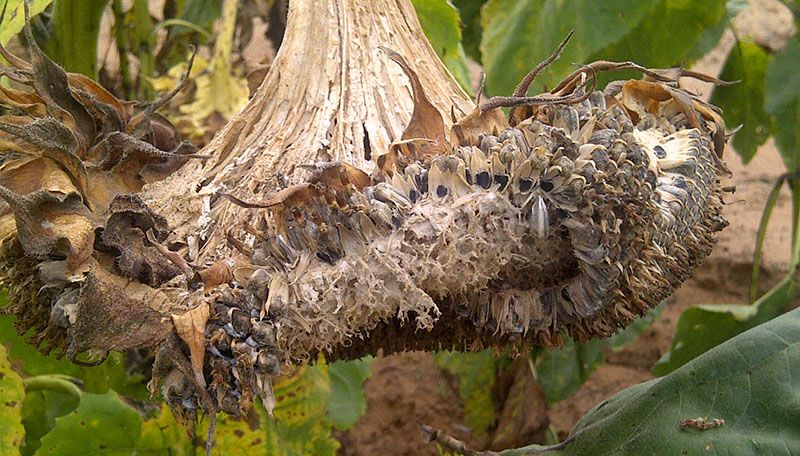
- Head (most harmful) form. It appears from the beginning of flowering to seed ripening. A brown, wet spot appears on the back of the head, which grows quickly and softens the tissues and rots. On the face of the head, under the seeds, a dense white coating forms. Consequences: the infection spreads to the face as a dense white coating, the seeds die, and large black sclerotia form inside the head and between the seeds. This leads to the greatest yield losses.
Effective protection of sunflower against sclerotinia.
1. Agronomic methods of protecting sunflower against white mould (sclerotinia). Effective containment of this disease is possible only by reducing the amount of infection in the soil, on plant residues and seeds. This is exactly what preventive agronomic measures are aimed at, which must be a mandatory part of the growing technology. Unfortunately, in production processes, due to economic constraints, farms often abandon basic elements of protection. Violation of crop rotation, refusal of deep tillage and dense crops lead to the accumulation of the pathogen in the plough layer. As a result, sclerotia remain viable for many years and become a permanent source of infection, causing regular disease outbreaks and yield losses. Protection against white mould is necessary because the main source of infection is precisely in the soil, where the use of chemicals is practically impossible. Sclerotia germinate throughout the entire growing period and infect plants at various development stages, so agronomic techniques play a decisive role in reducing the disease's harmfulness.
2. Crop rotation as a key factor in fighting white mould. The key element in this system is crop rotation. Returning sunflower to the same field no earlier than 4-5 years later allows the infectious load to be significantly reduced, since a large part of the sclerotia loses its ability to germinate during this time. Equally important is deep tillage, which buries the affected plant residues to a depth of more than 15 cm. Under such conditions the pathogen cannot develop actively and gradually dies. In addition, these measures are complemented by optimal crop density, since excessive thickening creates increased humidity and poor ventilation, which favours the development of white mould, whereas a correctly formed stand density significantly reduces the risk of infection.
3. Fungicide protection against sclerotinia (white mould): when you cannot do without fungicides. Chemical protection today remains one of the key elements in the system of fighting sclerotinia. With a high infectious background, favourable weather conditions and saturated crop rotations, agronomic measures are often insufficient, so the use of fungicides is necessary to preserve the yield and its quality. Fungicide protection allows the disease's development to be controlled directly in the crops at the most vulnerable development stages of sunflower. Boscalid-based products work systemically and effectively contain the pathogen's development inside the plant. Therefore, for protection against sclerotinia, the DEFENDA brand has products such as: RADICAL (boscalid 500 g/kg) and RADICAL NEO (azoxystrobin 250 g/l + boscalid 150 g/l).
Boscalid belongs to the anilide chemical class, has a unique mechanism of action that differs from other fungicides. It inhibits the mitochondrial respiratory chain of the fungus Botrytis cinerea, blocking the synthesis of ATP — the cell's main energy source. Thanks to its systemic action, boscalid is distributed throughout the plant, providing long-term protection against infections.
So, sclerotinia is a serious threat to sunflower yield and quality. Effective control of the disease is possible only by observing crop rotation, carrying out deep tillage and using fungicides. Timely prevention and constant field monitoring are the key to successful protection and a consistently high sunflower yield.
Author: Oleksandr Kotyhora, Agri-technology Development Manager for the Southern region