2026
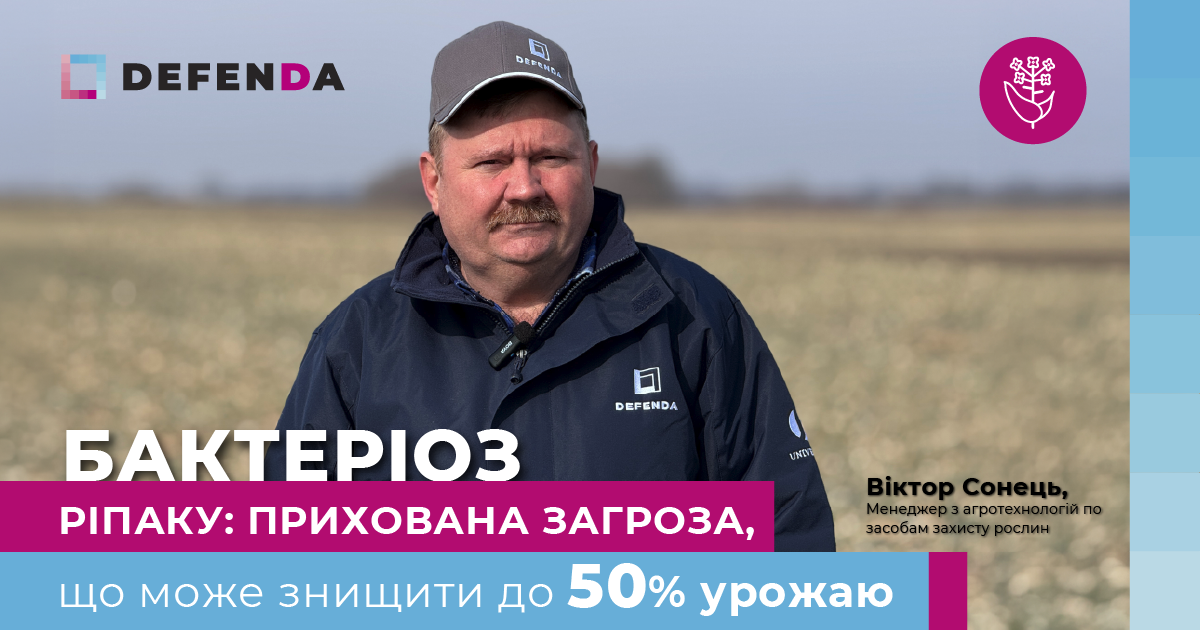 Over the last few years of growing winter rapeseed in Ukraine, producers have encountered an unusual disease — root bacteriosis, caused by the bacterium Xanthomonas campestris.
Conditions of spread
To obtain emergence, which is linked to the presence of moisture in the soil, sowing is carried out at overly early dates, and accelerated growth of the above-ground vegetative mass is observed; in the 1st-2nd ten-day periods of September, cavities form inside the roots near the root collar (root hollowness), which the bacteria Xanthomonas campestris infect, with gradual browning of the core. During the resumption of vegetation, first white and then dark-brown oily spots form on the lower parts of the leaves. Hollowness forms because the plant's intensive water consumption does not match the growth of the parenchyma tissue of the root system. In addition, excessive consumption of nitrogen fertilisers negates boron application, which also significantly affects hollowness.
The disease's development is also favoured by exposure of the root collar when the seed is sown into loose, unrolled soil. The formation of an adhering ice crust on rapeseed crops in winter and early spring 2026 is also one of the conditions for the spread of bacteriosis.
The source of bacteriosis infection can also be the root residues of wild rape (charlock); in autumn 2025, wild rape flowering was a mass phenomenon on practically all rapeseed crops.
The spread of bacteriosis is also favoured by rapeseed pests (the rape sawfly, the diamondback moth), the outbreak of which in autumn 2025 on winter rapeseed crops exceeded the economic threshold of harmfulness.
When growing rapeseed on acidic sandy, loamy, floodplain soils (pH 4.0-5.8) at a soil temperature of +18-20°C, the disease's development is most intense. On these soils, for rapeseed, iron, aluminium and manganese reach toxic concentration levels, and at the same time the intake of phosphorus, potassium, sulphur, calcium and magnesium into the plant is problematic, which in turn blocks sugar accumulation.
Root bacteriosis is often the cause of a reduction in winter rapeseed yield by 45-50% and more.
Externally the disease almost does not manifest itself and can only be detected with a longitudinal cut of the roots. By the beginning of spring, most of the affected roots become slimy, which leads to plant death. In infected plants the leaf rosette easily separates from the main root.
Photo 1. 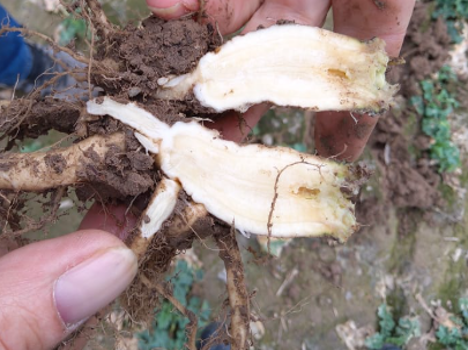
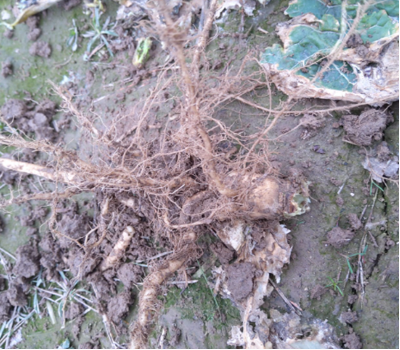
Some damaged plants after wintering begin to form new leaves at the expense of nutrient reserves in the head of the rosette, but do not reach normal sizes, begin to wilt and dry out. Under favourable overwintering conditions, infected plants can form generative organs, but give a yield 40-50% lower than healthy ones.
Photo 2.
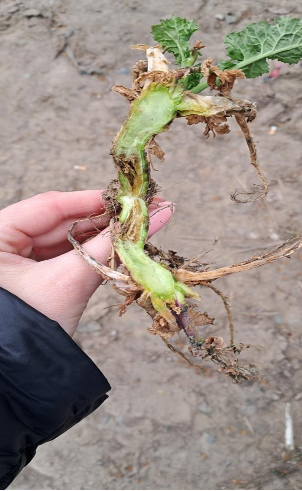
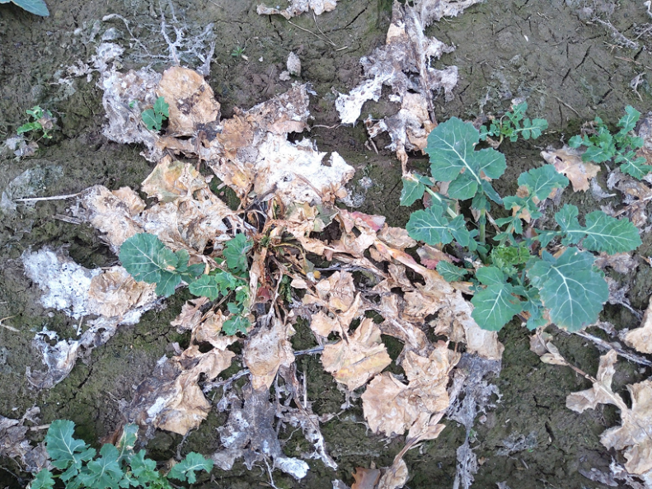
Infected plant
For the protection and prevention of winter rapeseed bacteriosis caused by the bacterium Xanthomonas campestris, the DEFENDA brand portfolio has the locally systemic fungicide Velas, SC, a fermentation product of the fungus Streptomyces kasugaensis, 60 g/l. Registered in Ukraine in 2025. In addition, Velas, SC has a preventive and curative action against bacterioses caused by the bacteria Erwinia (bacterial blight), Pseudomonas (bacterial canker and wilt).
Velas, SC affects the division and reproduction (proliferation) of bacterial cells, stopping protein synthesis, affects RNA, as a result of which the growth and reproduction of bacteria is stopped.
The product easily penetrates the plant tissues and is quickly distributed through them. This allows it to reach the sites of infection and act directly on the disease pathogens. At the same time there is no phytotoxic effect on rapeseed.
Application rate — 0.8-1.6 l/ha, amount of working solution — 200-400 l/ha. The application phase on winter rapeseed is stem elongation (BBCH 31-39). Application of the product is also possible in the regrowth phase (BBCH 21-29), but there is a limitation on the temperature regime, the optimal application temperature is from +15°C.
In addition to registration on rapeseed, Velas is registered on tomatoes (bacterial spot), cabbage (slimy bacteriosis, bacterial blights), apple (slimy bacteriosis, bacterial blights), soybean (bacterial wilt, bacterial blight), sunflower (bacterial blight, bacterial head rot, bacterial leaf spot), wheat (basal bacteriosis, black chaff), as well as on berry crops (bacterial blight).
Viktor Sonets, agronomist of the DEFENDA brand, PhD in Agricultural Sciences