2026
While the combines move on to threshing wheat, sunflower is filling its seeds and building up oil. Yet this is exactly when head diseases become active in the field — the ones that eat the yield quietly and unnoticed while the agronomist is busy with the harvest. Losses from rots can reach 60% of the yield.
At today’s sunflower prices, every single percent is real money.
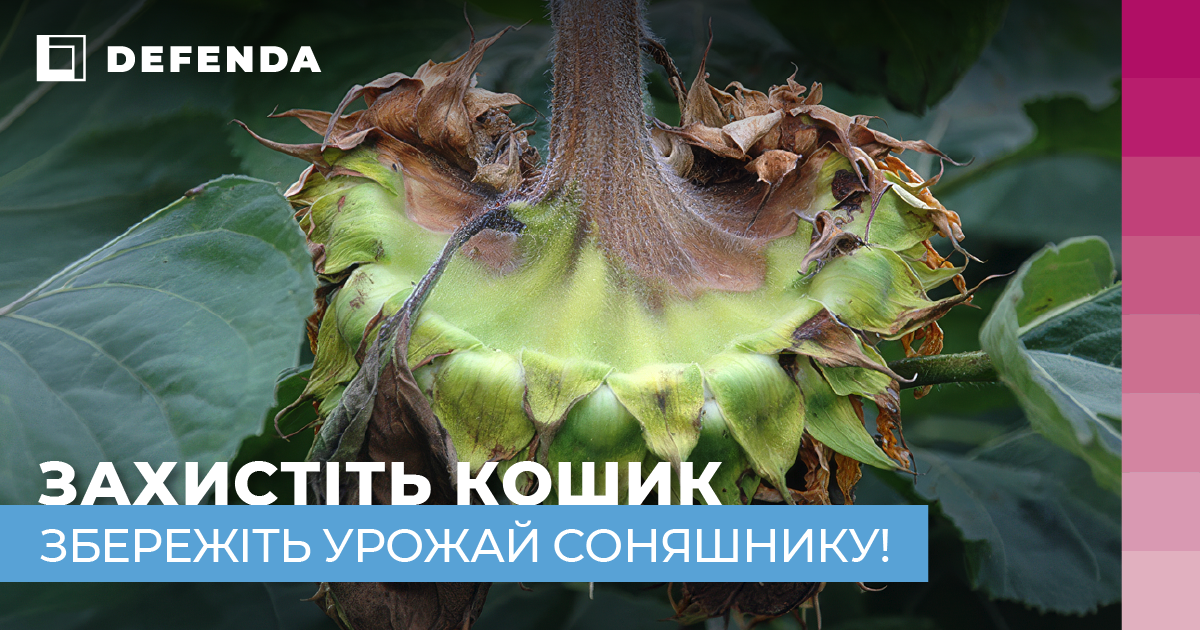
Serhii Korniushenko, Agricultural Technology Manager for the Eastern Region at LNZ Group, explains which head diseases dominate this season, and when and with what to treat sunflower.
Alternaria and white mould have dominated in recent seasons
The main pathogens of sunflower head diseases are:
- grey mould — appears on the back of the head;
- white mould (sclerotinia) — affects the head, the stem and the leaves;
- dry rot — typical of hot and dry weather;
- alternaria — present at all stages of plant development.
On the heads, alternaria primarily attacks the bract leaves and spreads rapidly from there.
Alternaria is favoured by rainy weather and morning dew. In an affected head the seeds are underdeveloped or fail to form at all. According to Serhii Korniushenko, the diseases are present every year, but whether they become widespread depends on the conditions. In ordinary years the infection level is 1–10%. Alternaria and white mould have dominated in recent seasons. Dry rot is a problem in individual dry years.
«This year, given the good moisture supply in the Dnipropetrovsk and Kharkiv regions, we expect three diseases to prevail at the same time: alternaria, white mould and grey mould», — explains Serhii Korniushenko.
The first signals — what to look out for
Crop scouting is the first condition of timely protection, LNZ Group agronomists insist. But there is also an indirect signal that often precedes the appearance of rots — pests.
«On sunflower we find the cotton bollworm, the meadow moth and grass bugs, which cause characteristic damage to the heads and leaf petioles. For the eastern and southern regions the problem is the sunflower stem beetle and the sunflower moth», — adds Serhii Korniushenko.
Bollworms and sunflower moths damage the protective layer of the head — and that is exactly how rot pathogens penetrate together with moisture. In other words, insects appearing in the field are already the first warning bell.
The second risk factor named by LNZ Group is a broken crop rotation. Sunflower returns to the same field after 3–4 years instead of the recommended 8. This builds up the infection background in the soil, which increases disease pressure year after year.
The third point is the quality of seed treatment. Fungicidal seed treatment must be mandatory. Everything else is an additional option and a matter of the farm’s purchasing capacity. It is the first and cheapest barrier against a whole range of pathogens, including white mould.
White mould is too late to cure — it has to be prevented
White mould is a special case. It develops in stages: first on the seedlings, then on the stem, and only after that on the head. And by the time the damage is visible, the moment has already been lost.
Once white mould is already in the field, its development can be partly stopped, for example with products based on bendazim (Absolut). But the disease cannot be eliminated completely — part of the yield is already lost. Further development depends on temperature and humidity: in hot, dry weather the progress may stop, in wet weather it will continue.
«Once it has already appeared, you can partly stop its development, but it will keep developing depending on the temperature regime and the moisture. That is why it is better to protect preventively», — stresses Serhii Korniushenko.
Basic prevention means high-quality seed treatment with products that act specifically against sclerotinia. Fungicide applications during the growing season only work if you are in time, before the symptoms appear.
The basic head protection programme
The key phase is budding. Preventive fungicides must be applied precisely before the start of flowering. Fungicide protection should be combined with insecticides.
The following products from the LNZ Group portfolio are suitable for head protection:
- Radikal Neo (azoxystrobin + bascolit).
- Absolut — rate of at least 1.5 l/ha; effective against the same diseases.
As for insecticides, the choice depends on the phase:
- if flowering has not started yet — Oktant Turbo (lambda-cyhalothrin + thiamethoxam) or Presto — 0.4 l/ha;
- if flowering has already begun — products based on thiacloprid (Synerid) — 0.4 l/ha;
- Kairos — rate of 150 g/ha, controls the bollworm and the sunflower moth (lepidopteran pests).
LNZ Group notes that these contact-systemic insecticides are able to protect sunflower against pests for 21–25 days, which in turn means fewer diseases.
The critical damage threshold
The critical threshold of rot damage is 10% of the plants. At that level there are already direct yield losses, and losses from rots can reach 5–60%.
«With 3 t/ha of sunflower, 10% damage already means 300 kg/ha of losses. At today’s prices for inputs that is very tangible. Every single percent is worth fighting for», — says Serhii Korniushenko.
At 2–3% damage the situation is not yet critical, but it needs monitoring. If the weather stays warm and wet, the disease will develop further. If it turns dry and hot, it may stop.
The approximate cost of head protection:
- fungicides — $30–40/ha;
- insecticides — $10–30/ha depending on the pest and the products chosen.
How to physically apply the product to tall sunflower
This is the practical question that stops many growers. There are two options:
- A self-propelled sprayer with high clearance — if the farm has one or can hire it. The spray solution rate for fungicides is a minimum of 200 l/ha.
- Drones — if there is no ground equipment. The spray solution rate is a minimum of 10–12 l/ha. At 8 l/ha the efficacy drops. Some farms paid more this season but insisted on 12 l/ha — and got a positive result.
Application conditions:
- temperature — up to 25°C, better 2–3 hours before that mark is reached;
- no dew;
- wind speed — no more than 3–4 m/s.
«At a wind speed of 10–12 m/s you will get heavy drift — you have no idea what you covered and what you did not», — warns Serhii Korniushenko.
The main mistake of the season
The harvest is a distraction. While the farm is busy harvesting wheat, sunflower is left unattended. And when the agronomist finally gets out to the field, the situation there may already be critical.
«This season the sunflower moths and bollworms emerged two weeks late because of the weather. Whoever was not scouting missed the moment. Farms are busy with harvesting right now and are a little distracted», — says Serhii Korniushenko.
This season the crops are running late — the May sowings are still at the budding stage. So the window for a preventive treatment is still open. But it will not stay open for long.
«It is better and cheaper to apply preventively now than to rescue what is left afterwards. This is not the place to save money», — the specialist concludes.
Source: kurkul.com