2026
Soybean planted area in Ukraine exceeded 2 million hectares this year. Despite the forecasts, there was no significant reduction in the area under this legume — and although the market and prices keep fluctuating, once the crop is in the ground the priority is to protect the yield as fully as possible. All the more so because the season started under stress. Conditions are now shaping up in a way that leaves crops exposed to a range of threats that must be kept under control. Below we look at the main problems and how to solve them.
 The state of soybean crops in Ukraine in June 2026
As Serhii Ivaniuk, Agrotechnology Development Manager for the Central Region at LNZ Group, explained, this year's soybean sowing began in the second ten days of April. These crops experienced a marked drop in temperature, and emergence took, on average, 11–18 days, whereas with later sowing seedlings appeared in 9–12 days.
«Cold soil and low air temperatures delayed emergence. Later, plants had a low central stem (weak initial hypocotyl growth with intensified anthocyanin colouring); in varieties genetically predisposed to more branching, lateral branches formed in the axils of the cotyledonary, primordial and first trifoliate leaves. In varieties not prone to branching, a shorter hypocotyl leads to a low set of the bottom pod and, at harvest, to yield loss. Every pod left on the plant costs roughly 0.1 t/ha (1 c/ha) in yield,» he explained.
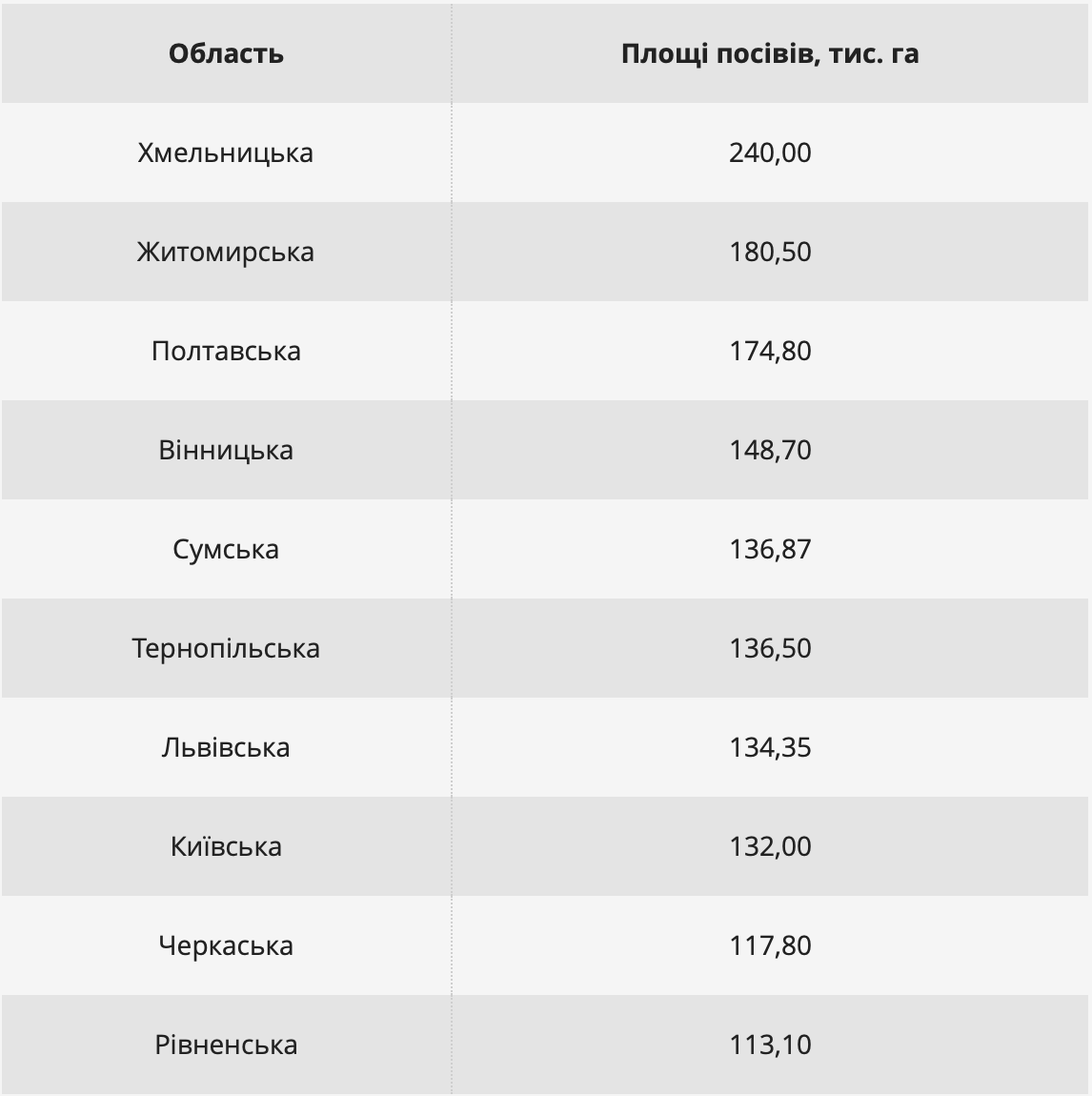
According to the specialist, within the main soybean-growing regions (the largest areas are in Khmelnytskyi, Zhytomyr, Poltava, Sumy, Ternopil, Kyiv and Vinnytsia oblasts) the best plant growth and development is seen in the south of Cherkasy and Vinnytsia oblasts, as well as in the northern part of Kirovohrad oblast.
Top-10 oblasts by soybean planted area as of 08.06.2026 (Ministry of Economy data)
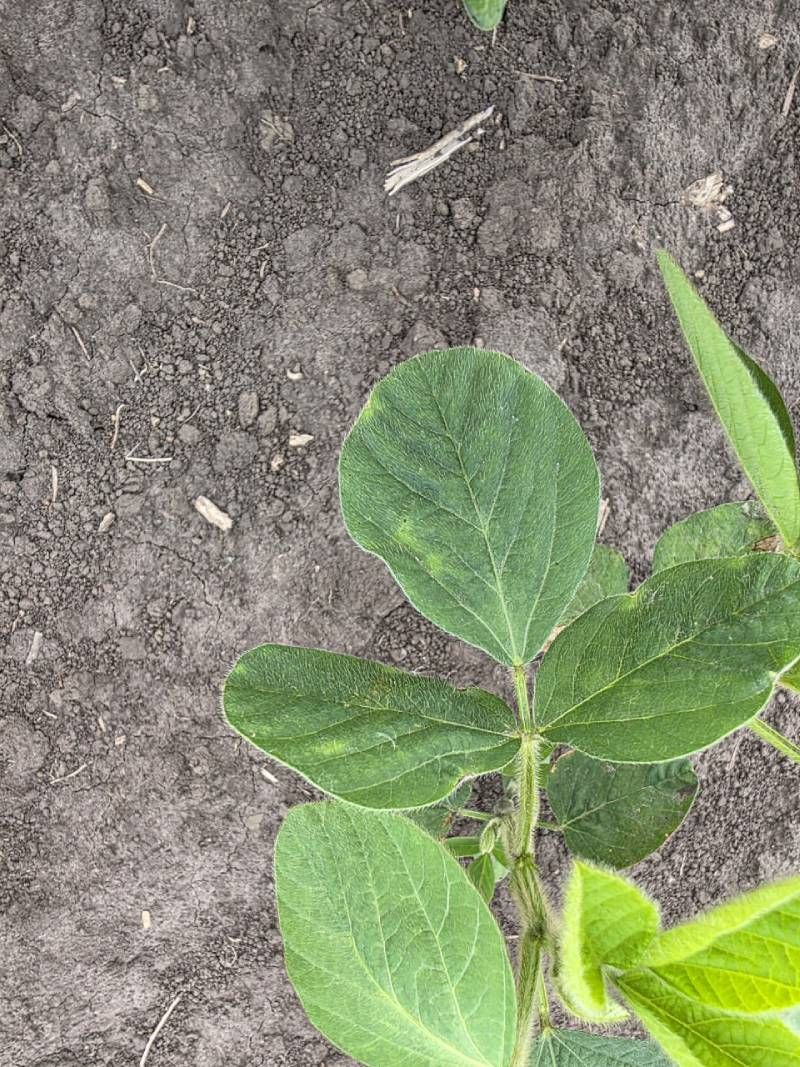
Rostyslav Kyryliuk, Agrotechnology Development Manager at LNZ Group, noted that as of late June soybean crops in most regions of Ukraine are at V3–V8 (3–8 trifoliate leaves), while on earlier crops in the central and southern oblasts plants have already reached full flowering (R2).
Overall, crops are rated as good, but the weather has created substantial differences between regions:
Western Ukraine
Sufficient moisture and a moderate temperature regime ensured uniform crop development, albeit with some delay. At the same time, frequent rains created favourable conditions for the first fungal diseases — in particular Septoria, Cercospora and bacterial blights. On some fields a second wave of weeds is emerging, which requires constant monitoring.
Central region
The central oblasts offer some of the best conditions for soybean. Most crops are even, actively building vegetative mass and a strong root system. At the same time, where rainfall is uneven, pests are already appearing.
Northern Ukraine
In the north, crop development was somewhat held back by the cool spring, but once temperatures stabilised the plants moved intensively into growth. The main focus now should be on controlling bacterial and fungal diseases, especially after prolonged rains.
Southern Ukraine
The south remains the most contrasting region. Because of a deficit of productive moisture, some crops are under stress, particularly on light soils. In such conditions the primary risks are pests rather than diseases. Any rainfall in this period is decisive for further yield formation.
 As Rostyslav Kyryliuk stressed, the current period is one of the most important in soybean growing technology. Right now it is essential to focus on:
- monitoring crops for diseases and pests;
- assessing the efficacy of herbicide protection and controlling repeat weed flushes;
- appropriate fungicide protection, especially in regions with sufficient moisture;
- controlling pest numbers — above all spider mite and other sucking pests in arid regions.
«The budding to early-flowering stages are decisive for the initial set of soybean generative organs. Any stress in this period — competition with weeds, disease development or pest damage — directly affects the number of pods, the number of seeds per pod and future yield. Systematic monitoring and timely use of protection products are therefore key elements of the growing technology that make it possible to realise the crop's genetic potential in full,» the specialist emphasised.
Protecting soybean under unstable weather conditions
The weather contrasts of recent years have become one of the main factors affecting the efficiency of soybean growing technology. The transition from cool, wet weather to high temperatures and moisture deficit puts the crop under stress that can hurt yield formation. «If this scenario unfolds at the budding to early-flowering stage (R1–R2), plants may respond by pausing growth, partially shedding flowers and reducing the number of future pods, and the fruiting elements then form as an inverted pyramid along the plant.
If drought coincides with pod formation and fill (R3–R5), the risk of a lower pod count and smaller seed increases,» notes Rostyslav Kyryliuk.
At the same time, a prolonged period of elevated humidity is one of the most favourable factors for fungal and bacterial soybean diseases. Under such conditions, even fields with a low initial infection background may require enhanced fungicide protection.
At flowering (R1–R2), the risk of Septoria, Cercospora and bacterial leaf spots rises. Damage to the leaf apparatus at exactly this stage reduces the intensity of photosynthesis and weakens the formation of generative organs.
During pod formation and fill (R3–R6), high humidity can promote anthracnose, white mold, Fusarium and other diseases that affect stems, pods and seeds. The result is poorer grain fill, lower sowing and marketable quality, and greater yield losses.
Beyond the direct impact of diseases, prolonged rains create another challenge — they make it harder to carry out field operations on time. Because of the limited technological window, farms cannot always perform fungicide treatments at the optimal timing, which significantly reduces their efficacy.
In such a scenario, the protection system should be based not on reacting after mass symptoms appear, but on a preventive approach. Regular crop monitoring, assessment of weather risks and timely fungicide application at critical crop stages help preserve a healthy leaf apparatus, ensure full pod formation and maximise yield potential. Preventive protection in years with high moisture supply is one of the key elements of an effective soybean growing technology.
Threats from the most harmful soybean diseases and their control
Of course, the first steps to protect soybean crops from infection must be taken before the seed even goes into the soil.
«From farm experience, I can say that treating seed with the fungicidal seed protectants Fuksia (fludioxonil, 25 g/l) and Ares (metalaxyl-M, 350 g/l), together with the insecticidal Metaksa (thiamethoxam, 350 g/l), delivered "healthy" (symptom-free) seedlings without pest damage during the spring of 2026, which was unfavourable for soybean growth and development,» Serhii Ivaniuk noted.
According to him, this year soybean crops showed, among others, downy mildew (Peronospora), Cercospora and bacterial blight.
The DEFENDA brand portfolio includes a range of products that have proven quite effective against the pathogens of these diseases. Serhii Ivaniuk recommends the following schemes:
- Ultralin (cymoxanil, 300 g/kg + azoxystrobin, 250 g/kg) — 0.5 kg/ha;
- Dot (cyproconazole, 80 g/l + propiconazole, 250 g/l) — 0.5 l/ha + Salto (thiophanate-methyl, 500 g/l) — 1.0 l/ha;
- Split Duo (difenoconazole, 125 g/l + azoxystrobin, 125 g/l) — 0.8–1.0 l/ha;
- Velas (Streptomyces kasugaensis fermentation product, 60 g/l) — 0.8–1.6 l/ha.
Against these fungal diseases — especially anthracnose, Ascochyta, Fusarium and white mold — during the reproductive period of soybean development, Rostyslav Kyryliuk recommends the fungicide Radikal Neo (azoxystrobin, 250 g/l + boscalid, 150 g/l).
«The combination of a strobilurin and an SDHI fungicide provides preventive, curative and long-lasting protective action against a fairly wide spectrum of diseases at once. On soybean the product is recommended at 0.7–0.8 l/ha. The optimal application window is budding to early flowering (R1–R2). It is precisely then that the crop's generative potential starts to form, while the weather often favours the first leaf infections,» the specialist says.
According to him, besides the direct fungicidal effect, the strobilurin component helps keep the leaf apparatus photosynthetically active for longer, which is especially important during pod formation.
Another solution for controlling the disease complex is Taler Max (tebuconazole, 500 g/l), applied at 0.25–0.5 l/ha.
«The product has a pronounced curative and protective action and is appropriate when the weather favours rapid infection development or when the first disease symptoms have already been detected during crop monitoring,» says Rostyslav Kyryliuk.
On soybean, Taler Max is best applied from the start of flowering to pod formation (R2–R4) to control the complex of fungal diseases and curb further spread of infection.
«The choice of protection scheme should be based on the weather, the previous crop and the field's infection background. At low to moderate disease risk, a single fungicide treatment at R1–R2 with Radikal Neo is enough to provide long-lasting leaf protection,» the specialist stresses.
He adds that if the season is marked by frequent rains, high humidity and a prolonged flowering period, a two-stage protection system is advisable:
- Radikal Neo (0.7–0.8 l/ha) — at the start of flowering, for prevention and to curb the development of the main leaf infections.
- Taler Max (0.25–0.5 l/ha) — during pod formation, when additional protection of the generative organs and extended fungicidal action are needed.
«Fungicide protection of soybean today is not only about fighting diseases that are already present — above all it is a tool for preserving yield potential. Fungicides are most effective when applied preventively or in the early stages of infection, before the leaf apparatus has been substantially damaged,» Rostyslav Kyryliuk emphasises.
For his part, Serhii Ivaniuk stresses that, as the shares of sunflower, rapeseed and soybean in the cropping structure grow, two fungicide applications are already becoming mandatory — and production costs rise accordingly. So in their decisions, farmers have to strike a balance in designing the crop rotation (taking into account the market situation, crop demand and margins) and in choosing protection schemes that weigh both the efficacy and the cost of the products used.
General rules for protecting soybean from diseases, from LNZ Group specialists:
1. To successfully fight harmful organisms, you need to know their biology; and to make the right decision (applying plant protection products) you must understand the biological and economic thresholds of harmfulness (ETH).
2. Correctly matching product active ingredients to the target organisms is the key to removing a specific problem that could otherwise lead to yield loss.
3. Regular, planned scouting of soybean crops is essential for a timely response to the challenges that may arise during the season.
4. Refining agronomic experience for each individual field makes it possible to arrive at effective decisions — a precondition for positive financial results.
Source: superagronom.com