2021
The global energy crisis and the industrial crisis in China have hit the industry producing active ingredients for pesticides hard. How likely is a scenario of a crop protection product shortage on the Ukrainian and global markets in the new season? Won't the amount of counterfeit products increase in that case? How has Ukrainian farmers' attitude to generic products changed? Why shouldn't you save on fertilizers? All this is discussed in an interview by the head of the chemical division and the brand DEFENDA LNZ Group Serhii Borysov.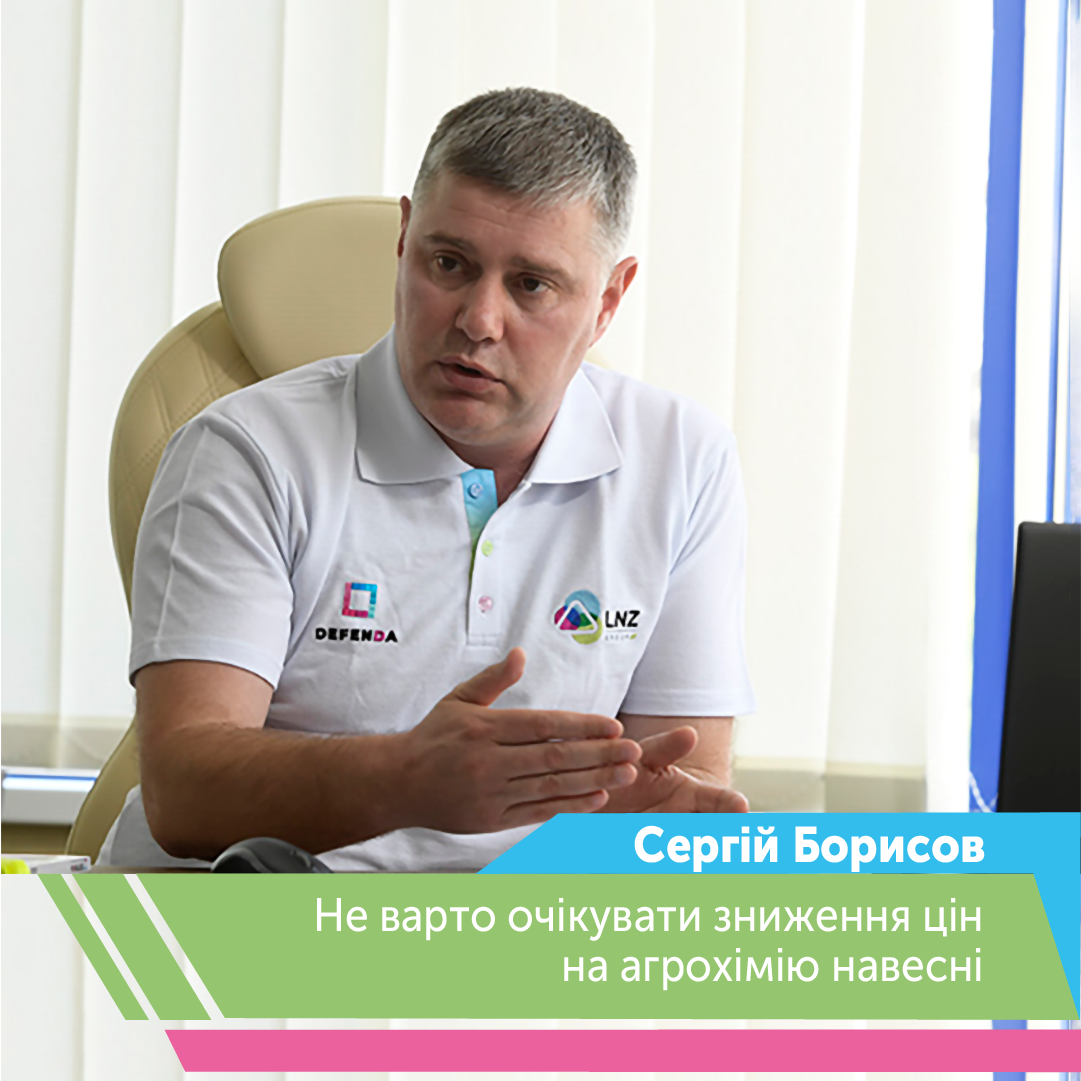
Latifundist.com: At the end of the year it is customary to sum up results. But let's start with what made the 2021 season memorable for you personally?
Serhii Borysov: The season was interesting. The beginning of spring was unusual. For example, the eastern regions have probably never seen such a wet spring and summer in the entire history of the country's independence. The same goes for the southern regions: last year there was less rainfall than in three months of this year. If 10 years ago droughts in Poltava and Chernihiv regions were rare, they are gradually becoming the norm.
All these weather «swings» cannot but affect plant health. Heavy rainfall in Odesa region led to the emergence of fusarium head blight. And for this region it is not a typical disease at all. A similar situation occurred in the «sunflower belt» — the eastern and central regions. A dry summer followed by a cold and rainy autumn led to grey mould developing throughout the belt. Although this disease is rare for this area. Therefore, those agricultural producers who carried out fungicide treatment got at least some harvest. Those who did not work with fungicides got a result half of what was planned. Desiccants also had to be used to save the harvest somehow.
What am I getting at? That climate change forces agricultural producers to look for ways to fight diseases and weeds that used to be rare in their region.
Latifundist.com: Considering all these challenges, which pesticides were in the highest demand this season?
Serhii Borysov: Because of weather «surprises», there was demand for glyphosate-group herbicides. We saw this especially in the southern regions. At the same time, the increased demand for glyphosate-group products in regions where they had not been used before led to a decrease in stock carryover for 2022. All importing companies entered the new season with minimal stocks of glyphosate-group pesticides.
Latifundist.com: How much did agrochemical products rise in price then?
Serhii Borysov: This season, logistics prices increased. Due to the pandemic, supply chains around the world were disrupted. Delivery times increased due to a shortage of containers. As a result, logistics prices rose 4-5 times. Of course, all this could not but affect the production cost. Depending on the product, the cost increased by 10-15%. The more expensive the product, the lower this percentage.

Latifundist.com: What other factors affected prices?
Serhii Borysov: Here it should be explained that the price increases came in three waves and began at the start of the year. I have already talked about the first wave — logistics. It caused product prices to rise from January 2021.
The second wave was the reduction in yellow phosphorus production in China. In August, the only plant producing this substance cut its output threefold. This is due to environmental standards, as yellow phosphorus production is the most toxic production in the world. At the same time, yellow phosphorus is a raw material for glyphosate and other products. So what happened? There was a crazy rise in glyphosate prices.
The third price rise was recorded in September, when problems began on China's energy market. Due to the electricity shortage, the Celestial Empire restricted the production of active ingredients and formulations. Plants operate only 2-3 days a week. For example, if a plant used to produce 30 thousand l, now it produces 5 thousand l. But it still has to maintain the plant, the staff and service the production itself. Therefore, these costs were built into the production cost. As a result, for certain products the cost increased 5-6 times.
This caused a shortage of active ingredients and, accordingly, broken contracts. Add logistics problems here and we come to the conclusion that next year, 2022, will be much more difficult. Up to 85% of all global agrochemicals are concentrated in China. Therefore, one should not expect agrochemical prices to fall in spring.
Latifundist.com: What kind of year was it for the company in that case? Did you manage to increase sales?
Serhii Borysov: Of course, before the season we planned sales growth. Despite all the above factors, we coped with this task and showed quite good results. We grew by 25% in monetary terms and by 15% in the area treated with our products.
Latifundist.com: Agronomists often choose tank mixes to broaden the spectrum of action of products. However, this option is not always effective — instead of clearing the field of weeds, the agronomist gets a «bouquet» of new problems. Explain why such situations arise?
Serhii Borysov: It should be noted that the use of tank mixes is more effective than ready-made products. A farmer can solve the problem right in the field, reduce the load on the plant thanks to correct dosing and at the same time increase the product's effectiveness. He also saves on crop protection products — up to $30-50 depending on the crop. That is, at most he can increase the yield per 1 ha, and at least get the same effect, only for less money.
Returning to your question, I will note that agricultural holdings have long practised the use of tank mixes and see the real risk of it. But to avoid the «bouquet» of problems in the field you are talking about, they have hired highly professional agronomists. They know how to make tank mixes and when it is best to use them. There are very few such agronomists, and companies value them.
To grow your own specialist, it takes at least 1.5-2 years, and that is provided his basic knowledge is at a fairly high level.
How can those producers who do not have highly qualified agronomists on staff be helped? They can turn to us. We provide agronomic support to every enterprise that cooperates with us. That is, our specialists come to the farm and develop technological maps for a specific field: they select seeds, crop protection products and fertilizers to get the maximum result from every hectare. For now, we provide this service free of charge. But we see that companies are appearing on the market that do it for a fee. I think that in 2-3 years such outsourcing will be in greater demand.

Latifundist.com: Your specialists support farmers with a land bank of 20 ha. Few on the market do that.
Serhii Borysov: Yes, for managers 20-50 ha is economically unjustified support. However, we do it because we want the client to receive not just seeds or crop protection products, but a solution that will help increase the harvest. In addition, we provide a virtual consultation service, when a farmer can call a special service and get advice on a problem issue. Small farms with a land bank from 1 ha to 200-300 ha can turn to the online platform LNZ web.
Latifundist.com: The topic of counterfeits is relevant this year as well. What ways of minimizing counterfeit crop protection products on the Ukrainian market could you highlight?
Serhii Borysov: To defeat counterfeits, you need to make it unprofitable to deal in them. How to do it? As practice shows, there is no point in fighting with fiscal methods. We have already been through this in the past, when economic licences and import quotas were in force. Then there was control over warehouses, transportation and disposal. But there were far more counterfeits than now.
It is a complex problem, so it must be tackled comprehensively. On the one hand, state bodies should use their tools. On the other hand, the supplier companies themselves must fight it. For example, when we come to a farmer with a land bank of 20-50-100 ha (it is precisely him that counterfeits target), we explain why it is better to use quality crop protection products. We explain that if some force majeure occurs in the field, he can call us and get advice. Our specialists will come and help solve the problem. Does the seller of counterfeits bear responsibility for his product? Of course not.
Latifundist.com: In your opinion, if grain sales «for cash» were removed from the market, could that become a panacea against counterfeits?
Serhii Borysov: Of course. It is also a fight against the shadow land market. If the land is registered in your name, there is no point in working with counterfeits. Land registration is already being established in the country and, accordingly, there are fewer counterfeits — by 50% compared to 3-5 years ago.
Latifundist.com: In connection with the reduction in crop protection production we have already discussed, is there a risk that the amount of counterfeit products on the market will increase in 2022?
Serhii Borysov: There will not be more, because there will be nowhere to buy it. The product has to be bought somewhere, then imported and turned into a counterfeit. Since there is nowhere to buy, there is nothing to make counterfeits from.
Latifundist.com: More than 3 thousand enterprises in Ukraine have a licence to sell pesticides. In your opinion, should the state somehow regulate the issuing of licences or otherwise limit the number of players on the market?
Serhii Borysov: There is no point in limiting the development of any business area. If you want to move forward, you need competition. Without a competitive environment, development slows down. If in Ukraine we go through certain processes in a year, countries without a competitive environment take 5 years.
To build a crop protection business, you need to obtain registration, and that is not a cheap pleasure. In addition, you need distribution. And maintaining it becomes more expensive every year. Not everyone is ready to engage in this business.
Latifundist.com: The choice between generic and original products still causes discussions in agricultural circles. However, how much has the attitude of domestic farmers to generics changed today?
Serhii Borysov: In Ukraine it is no longer embarrassing to say that you work with generics. This was facilitated, in particular, by digitalization and free access to information. Now farmers with a land bank of 3-5 thousand ha name plants in China from which they would like to receive products. Previously, they did not even understand where those products were made and where they were imported from. With agricultural holdings it is a different story altogether. Before signing a contract, they always ask where the product will be supplied from, where and how it was produced, and what the supply chain is.
Latifundist.com: In October 2020, the EU lowered the maximum residue limits for chlorpyrifos and chlorpyrifos-methyl in food and feed to 0.01 mg/kg for oilseeds and cereals. A year has passed. Have Ukrainian farmers started to abandon this substance?
Serhii Borysov: Agricultural producers fear residual concentrations of this insecticide in grain, so they began to abandon its use. However, it is sold on the Ukrainian market and used, because there are still farmers who work with the technologies they are used to. They do not want to change anything in their work. Although alternatives to chlorpyrifos have long been on the market. These products are equally effective and efficient. As for price, chlorpyrifos at a rate of 1-1.1 l/ha costs approximately $7-10. Analogues cost the same, and in some cases even less.
Latifundist.com: You said next year will be difficult. What is your advice on how to prepare for it?
Serhii Borysov: The main thing is not to save on fertilizers and crop protection products, because ultimately such savings can cost dearly. We see that agricultural holdings held tenders back in July-August, chose suppliers and have already taken products into their warehouses. Farmers who buy products as needed will have much bigger problems. Because even with money they may not be able to buy the necessary products, since they simply will not be on the market.

So my advice is: prepare as much as possible for sowing, carry it out correctly and get the maximum harvest. To do this, think in advance about purchasing seeds, crop protection products and fertilizers. Since costs will be high, also choose the right crop for your farm.
Latifundist.com: Is it possible to save on fertilizers?
Serhii Borysov: You cannot save on fertilizers. You can save on hybrids and take a more professional approach to choosing them. If, for example, the farm is not in the «corn belt», choose a hybrid from the cheaper segment that will yield the same or higher. You can choose the right herbicide protection. Combine something somewhere or skip something.
Fertilizers are not something you can save on. You can reduce the rate in a given year if sufficient fertilizer was applied over the last 3-5 years. You can divide the field into two parts and increase the rate where the soil quality is better and decrease it where it is worse. The part of the field with low soil rating will give the same yield, and on the area with a higher rating you will get a higher yield.
Latifundist.com: Thank you for the advice and the interview!
Kostiantyn Tkachenko, Nataliia Rodak