2026
Attention to sunflower protection is always special. The crop is profitable, so it is worth the care. And there are plenty of problems. What possible threats to the oilseed crop there may be in the 2026 season, based on the experience of the previous year, and what means to counter them — we found out from the specialists.
 As noted by Rostyslav Kyryliuk, agri-technology development manager of LNZ Group, the climatic instability of recent years forms probable scenarios for which one needs to be prepared.
 In particular:
- a high probability of a repeat of a prolonged cold spring, and therefore a possible slowdown in the sunflower's initial development;
- uneven soil moistening will affect the stability of the soil herbicides' performance;
- excessive moisture during the flowering phase may be critical in terms of the development of fungal infections;
- temperature regimes may also favour the spread of pests, which require special and timely vigilance.
"Therefore, one must take into account the soil and climatic features of your region and select active ingredients according to the growing conditions, since some active ingredients are prone to leaching and may negatively affect sunflower emergence. For example, acetochlor, when leached, may have a negative effect on the crop's plants," added Rostyslav Kyryliuk.
Herbicide protection of sunflower — you cannot do without soil-applied products
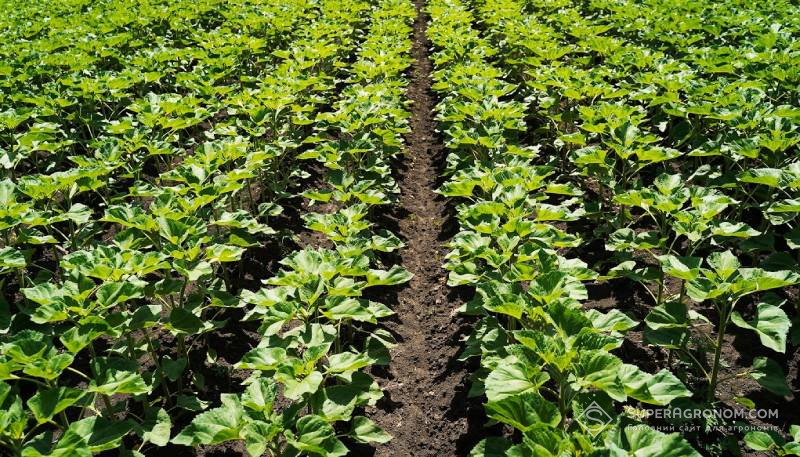 For the first 30-40 days after emergence, the crop grows slowly and has low competitive ability against weeds, so it is precisely soil herbicide protection that ensures a clean start for the crops and forms the basis for high productivity, says Rostyslav Kyryliuk.
"Through the use of soil herbicides, up to 2-3 waves of weed emergence can be controlled, which significantly reduces the load on the sprayers during the crop's active growth period. Subsequently, this ensures easier and more predictable control of the crops with post-emergence products, since a sufficient technological window remains for application even under unfavourable weather factors," he emphasises.
Annual broadleaf and grass weeds actively compete with sunflower for moisture, nutrients and light during the critical periods of root system development. Ignoring this stage can lead to yield losses of up to 40%, especially in fields with a high level of weed infestation.
Early suppression of weeds allows the plant to develop evenly, form a powerful root system and make maximum use of soil moisture and nutrient elements.
Thus, the use of soil herbicides allows the sunflower yield to be increased by reducing competition with weeds in the early development phases. In addition, this technology ensures peace of mind in the farm's work — there is no need to determine which field to treat first, since the crops are already protected and ready for further weed control.
As Serhii Korniushenko, agri-technology development manager for the Southern region of LNZ Group, notes, for example, in the south-eastern region last spring the sunflower sowing dates were quite stretched out, and this had a significant impact on the crop's vegetation, so farmers had to show flexibility, not always following pre-planned schemes, because problems arose "along the way".
"Last year the region's farmers began sowing sunflower in mid-April and finished in mid-June. So they had to face various problems. Firstly, a cold snap occurred on the early sowings, and downy mildew began to spread. Many refused to apply soil herbicides, because in places it even came to frosts and they understood that the products would either work insufficiently well or their duration of action would be shortened," the specialist says.
 How prolonged the current spring will be is not yet known, but temperature fluctuations with rises to 15°C and a sufficient amount of moisture provoke the germination of some weeds already now. In particular, overwintering weeds have also begun to vegetate.
"In our region many farmers have already 'learned the hard way' and understand that to get uniform sunflower emergence, you need to fight weeds at the initial stage. Therefore, at the slightest availability of moisture, they began to apply soil herbicides to sunflower. And not only with the classic technology, but also with the so-called 'chemical' one. Because by the time you wait for the right phase to work with the 'chemical' scheme, the weed will already have managed to overgrow and the post-emergence products will not work," explains Serhii Korniushenko.
The choice of products to eliminate the problem depends on several factors, primarily, of course, on the type of weeds. But the amount of moisture also affects the decision. Thus, in the central regions, where there is enough moisture, Literon (S-metolachlor, 960 g/l) works excellently against grass weeds on sunflower. Its active ingredient is a "specialist" in grasses, as Serhii Korniushenko says. The only thing to consider is that the product should not be applied at low temperatures, because S-metolachlor can crystallise under such conditions.
By the way, Literon is suitable for use on a whole spectrum of crops, and as Serhii Korniushenko adds, in the south it is quite widely used for herbicide protection of melons and gourds as quite effective and safe for these crops.
For drier conditions in sunflower protection, the specialist recommends Starlent (terbuthylazine, 190 g/l + propisochlor, 360 g/l).
"Propisochlor also specialises in controlling grass weeds, but is not as sensitive to the presence of moisture, so in the south-eastern, drier regions we place our bet on this product. And terbuthylazine removes broadleaf weeds well. So it turns out to be a double strike," he explains.
He adds that the range of application rates for Starlent is from 3.2 l/ha to 4.5 l/ha. Here you need to pay attention to the soil type. On sandy soils the application rate is reduced, and on chernozems you can safely apply the maximum rate.
Cutworms, moths, aphids — carrying over onto sunflower from last year
One of the problems that "carried over" from last year into the current one is pests. The weather at the end of winter spoiled their life a little, but on the whole the conditions for their overwintering were not bad. And if the summer is just as favourable for their reproduction and spread, then vigilance should be doubled.
"Last year in our region farmers faced damage to late sunflower sowings by cutworms and moths. Because the rise in temperature coincided with their emergence and they damaged the crop's shoots. In places so much so that the sunflower had to be resown," Serhii Korniushenko said.
Also, according to him, in the South, at high temperatures, mites were present, as well as tobacco thrips. This phenomenon has been observed for the second year in a row. It is possible that it will recur this year too. So it is worth preparing for additional treatments. This also applies to cutworms and moths, for which in places additional work had to be done already on the head, which was problematic, because not many farmers in the region have high-clearance sprayers. And aircraft or drones, of course, are currently banned here.
The variety of pests requires enhanced monitoring at various stages of the crop's vegetation.
If the spread of cutworms and moths falls in the period before flowering, then the insecticide Kairos (flubendiamide, 480 g/l), aimed precisely at these pests, will be effective, notes Serhii Korniushenko.
If, however, the outbreak occurs already during or at the end of flowering, then it is better to apply Synerid (thiacloprid, 240 g/l).
"This product can be applied during flowering completely safely for bees. At the same time, it removes a wide spectrum of pests, the same cutworms, and aphids, etc. So, taking into account the stretched-out sowing dates, and therefore a longer period of favourable conditions for the various life cycles of pests, we have the opportunity to control them 'from two sides'. First treat with Kairos before flowering, and if the problem arises again already during flowering, then Synerid will help here," the specialist explained.
He emphasised that damage to the heads must not be allowed under any circumstances, because moisture will accumulate at the points of damage and a favourable environment will form for the appearance of head rots. Then losses can reach from 10 to 30% of the yield.
The application rate of Synerid is from 0.3 to 0.5 l/ha, depending on the accumulation of insects. If the aphid colonies are small, or first-instar cutworm caterpillars are only beginning to appear, then Synerid will cope even with minimal rates. If, however, this moment is missed, then the threat increases and here serious protection is needed, which the maximum rates will provide.
"Although I always say — do not play with minimal rates, it is better to immediately apply the maximum. Because it is impossible to conduct full monitoring of a field, sunflower especially. And somewhere there will definitely be areas with greater infestation, somewhere the sprayer will work worse, so you will not achieve a 100% level of protection this way. The risk of further losses will only increase," noted Serhii Korniushenko.
Because, for example, aphids regenerate quite quickly. And as for the cutworm, if a rise in temperatures is forecast, then the situation with "isolated" larvae, which the agronomist saw during the previous monitoring, will quite quickly change into mass reproduction.
Diseases on sunflower — the consequences of a saturated crop rotation
The profitability of sunflower determines its status as one of the main crops in Ukraine, but at the same time saturating the crop rotation with it favours the accumulation of infectious potential.
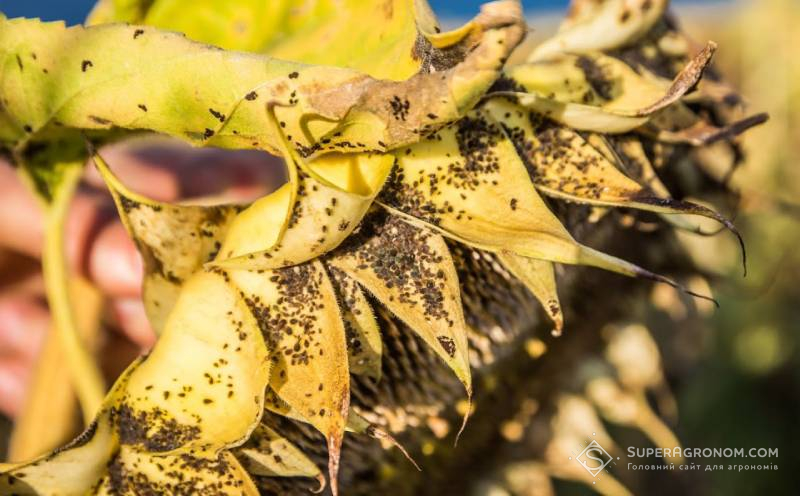 2025 was marked by an increased intensity of the spread of some crop diseases. And the pathogens that actively developed last season persist in the soil and crop residues, forming an increased infectious background, notes Rostyslav Kyryliuk.
First of all these are:
- white mould — with a short crop rotation the risk of stem and head infection remains high;
- phoma and septoria — capable of appearing already in the early development stages with sufficient moistening;
- downy mildew — probable in a cool and wet spring.
According to Serhii Korniushenko, in the south-eastern region last year the biggest problems on sunflower were alternaria and septoria. And on early sowings downy mildew spread.
"Under such conditions the universal product is the fungicide Dot (cyproconazole, 80 g/l + propiconazole, 250 g/l). Against downy mildew the tank mix of Stark (azoxystrobin, 250 g/l) with Dot works best, i.e. strobilurins and triazoles. If, however, you need to fight alternaria or septoria, then applying Dot alone is enough," noted the specialist.
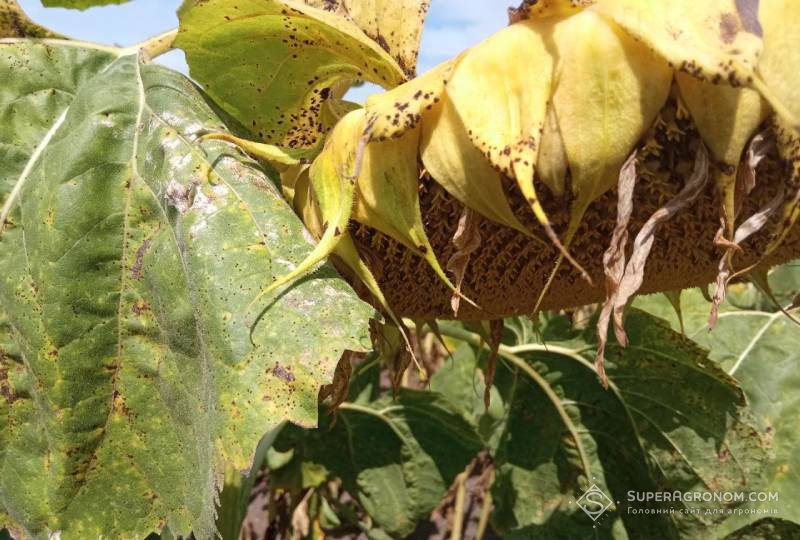 He added that for those diseases that are primarily a consequence of over-saturating the crop rotation with sunflower, the DEFENDA brand portfolio has a new product, Radical Neo (azoxystrobin, 250 g/l + boscalid, 150 g/l). The product is applied starting from the star phase and its active ingredients will very well remove pathogens and stop the potential spread of diseases, including sclerotinia.
As Rostyslav Kyryliuk sums up, the key tools for minimising risks for sunflower, as for any crop, remain systematic monitoring of the crops, flexible adjustment of protection schemes and taking into account the regional features of the formation of the phytosanitary load.
Source:superagronom.com