2026
Due to force majeure circumstances related to soybean in 2025, this year's forecast for sown areas may decrease to the 2023 level — to 1.8 million ha. However, unfavourable weather conditions, low temperatures and an ice crust may lead to the resowing of winter crops with spring ones — as an option, with soybean. But spring will show this.
 The most profitable crops in Ukraine remain sunflower, corn, soybean and rapeseed — their profitability can exceed 40-50%. For farmers, production stability is determined not only by price, but also by the ability to quickly sell the produce. Soybean is the demand leader in processing and export and thus has two sales channels at once, which makes it attractive to grow.
Smaller areas, delayed harvest: features of growing soybean last season
Last year, according to the State Statistics Service of Ukraine, 2.08 million ha was sown with soybean, which is 24% less compared with 2024.
The agri-technology development manager for the Central region of LNZ Group, Serhii Ivaniuk, says that the weather conditions of 2025 across the country as a whole were not very favourable for the crop's growth and development.
"The first half of the growing season was characterised by a reduced temperature regime, which led to a delay in plant growth and development of up to 14-16 days, and this is a loss of growth energy and a reduction in productivity potential. At the same time, a decrease in yield elements in the lower tiers of the plants was traced — in the 1st-3rd internodes of the trifoliate leaf (especially of the mid-season and mid-late groups). Subsequently, the weather conditions were more favourable for the formation of yield elements, especially in the north-western regions of Ukraine. In fact, a significant number of pods were concentrated in the middle and upper tiers of the plants."
The ripening of soybean coincided with prolonged rains, which led to a late harvest. Thus, as of 21 November 2025, the harvest was gathered from 96% (1,989.0 thousand ha) of the areas sown with this crop, amounting to 4,722.9 thousand t.
According to LNZ Group observations, in 2025 the highest average yield was noted in:
- the Ivano-Frankivsk region — 3.2 t/ha;
- the Ternopil, Lviv regions — 2.9 t/ha;
- the Khmelnytskyi region — 2.8 t/ha.
Soybean expanded its range, but became more dependent on moisture
LNZ Group notes that due to changing climatic conditions in Ukraine over the last decade the soybean belt has shifted 220 km of northern latitude.
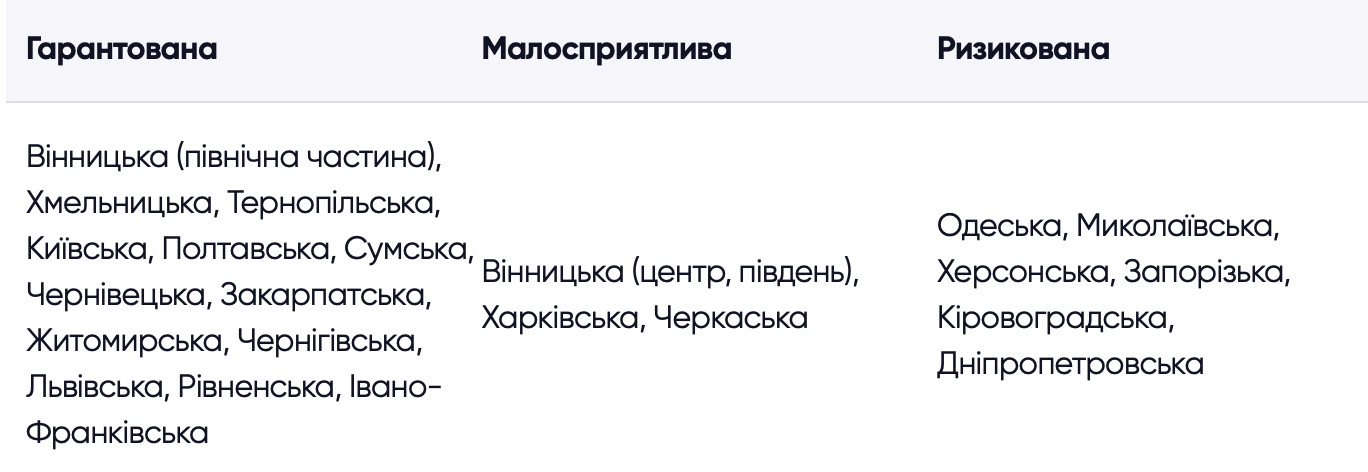
If earlier the Kirovohrad region was a guaranteed zone of soybean sowing, today it is included in the risk zone for growing consistently high yields. The Cherkasy and Vinnytsia regions have become of little use for soybean production. And in the Odesa, Mykolaiv, Kherson, Zaporizhzhia, Kirovohrad, Dnipropetrovsk regions, under unfavourable moisture-supply conditions, the yield was at the level of 1 t/ha, or even less, which makes growing unprofitable (table).
Soybean is a crop of a monsoon climate and needs warmth and moisture. According to Serhii Ivaniuk, to unlock its genetic productivity potential it needs on average about 4,500 cubic metres of water per hectare.
"The maximum moisture consumption of soybean falls on the formation of generative organs. With a moisture deficit during the period of laying yield elements, their number decreases, whereas during seed filling the seed size decreases, which leads to a yield shortfall. These periods are critical for soybean yield formation in terms of moisture supply."
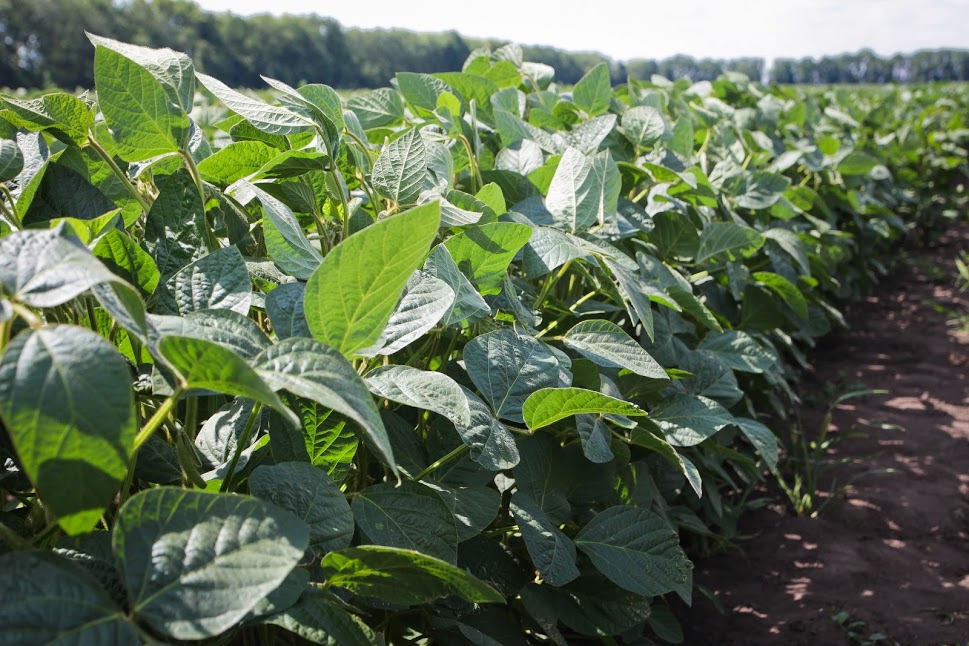 To somewhat reduce the impact of unfavourable moisture-supply conditions, the specialist advises farmers to consider varieties with an increased productivity level that belong to different maturity groups.
Diseases and pests: soybean requires at least two fungicide applications
LNZ Group reports that under the growing-season conditions of 2025, on soybean in the first half of the season downy mildew was noted, later — septoria, fusarium wilt, bacterial blight, purple cercospora and sclerotinia (white mould).
According to the company's manager, with an increase in soybean sowing areas in Ukraine with the saturation of the crop rotation with this crop, no fewer than two fungicide applications should be considered.
"It should also be taken into account that applying fungicides preventively has greater economic efficiency compared with expensive 'curative' fungicides. At the same time, one should consider the appropriateness of one or another active ingredient according to the disease pathogens, an understanding of preventive application, and only then take into account the price of the product, since a cheap product can be effective."
He adds that quality preservation of the forming yield was observed with a two-application fungicide scheme on the example of DEFENDA products:
- first application — Ultralin (cymoxanil, 300 g/kg + azoxystrobin, 250 g/kg) 0.5 kg/ha and second application — Dot (cyproconazole, 80 g/l + propiconazole, 250 g/l) 0.5 l/ha + Salto (thiophanate-methyl, 500 g/l) 1.0 l/ha;
- other products with the active ingredient azoxystrobin have proven themselves well for the first application — this is Split Duo (difenoconazole, 125 g/l + azoxystrobin, 125 g/l) 0.8-1.0 l/ha.
The specialist notes that 2025 was specific in terms of the presence of pests, namely: singly, but not en masse — the spider mite, an almost complete absence of the thistle painted lady, but Lepidoptera were widespread — the silver Y moth, the meadow moth, the acacia moth, the soybean pod borer and the cotton bollworm.
Given the situation, it was necessary to additionally apply Kairos (flubendiamide, 480 g/l) 0.15 l/ha + Cyrkul (lambda-cyhalothrin, 50 g/l) 0.2 l/ha + Super Macho 50 ml/100 l of working solution. Damage by the diamondback moth was also noted, especially where rapeseed volunteers occurred, it switched to soybean. In this case some soybean producers considered Prosens (emamectin benzoate, 100 g/kg) 0.25 g/ha.
Earlier, in time, Octant Turbo (thiamethoxam, 141 g/l + lambda-cyhalothrin, 106 l/ha) 0.25 l/ha + Super Macho 50 ml/100 l of working solution was applied.
Source: agroportal.ua