2026
An agricultural enterprise cannot be profitable without a team of specialists who work like a well-coordinated mechanism for a single result. The agronomist occupies one of the key positions in shaping the company's profit.
 An agronomist at an enterprise manages not their own capital, but the funds of the company's owner. They always want to buy better seed, more fertiliser, more effective crop protection products. And here it is important how ready the farm owner is to delegate decision-making authority and trust the agronomist. At the same time, the agronomist's expertise is also important: how professional a person they are, how able they are to forecast risky situations and understand that every hryvnia or dollar invested in the growing technology will bring profit.
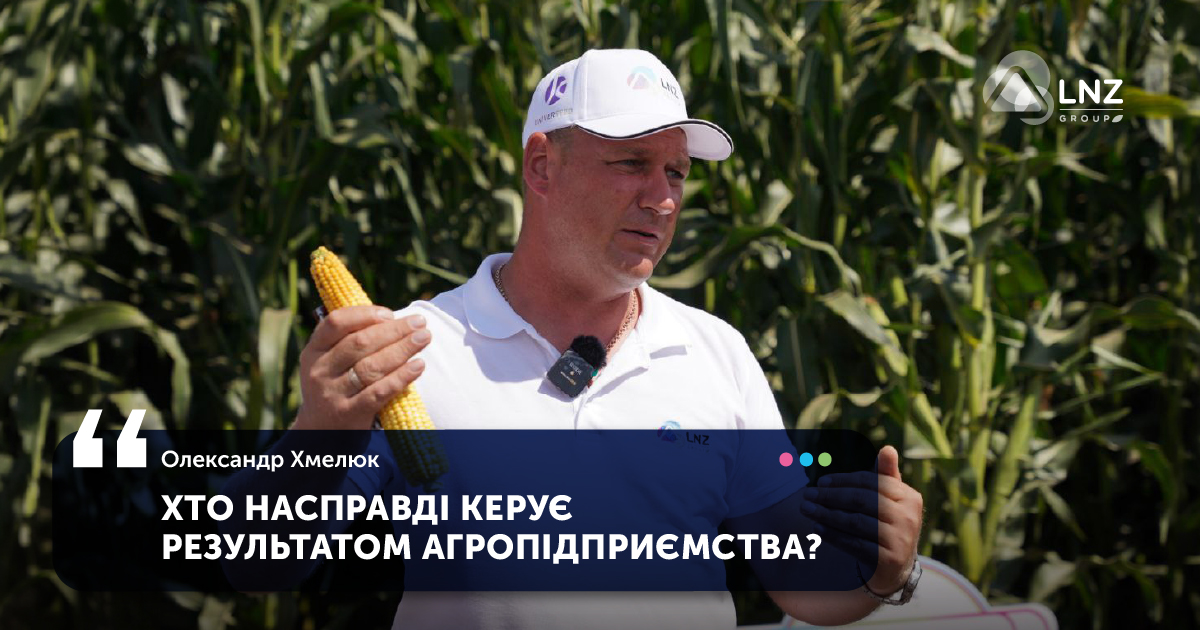
"The farm's costs are, in fact, expenses on production, fertiliser, seed, crop protection products, fuel, wages, logistics. There is also rent, which does not depend on either the agronomist or the owner. There are certain administrative expenses, and they do not relate to production, are not included in the cost price, they have to be paid already from the profit. There may also be social expenses, in particular on the restoration of communities, and many others. But since agricultural production is a means of earning money, accordingly, regarding economic efficiency the owner will always tell the agronomist to find ways to economise. Because reducing costs in another part is very difficult. That is, the resource of efficiency and economy is always sought in the technological map, in that expenditure part that can be changed." — Oleksandr Khmeliuk, head of the Agro Department of LNZ Group.
But here too a balance must be found. The agronomist's expertise is important, when they clearly understand what potential of seed is needed, what crop protection products can be used to preserve the potential. Moreover, the potential depends on each region and field.
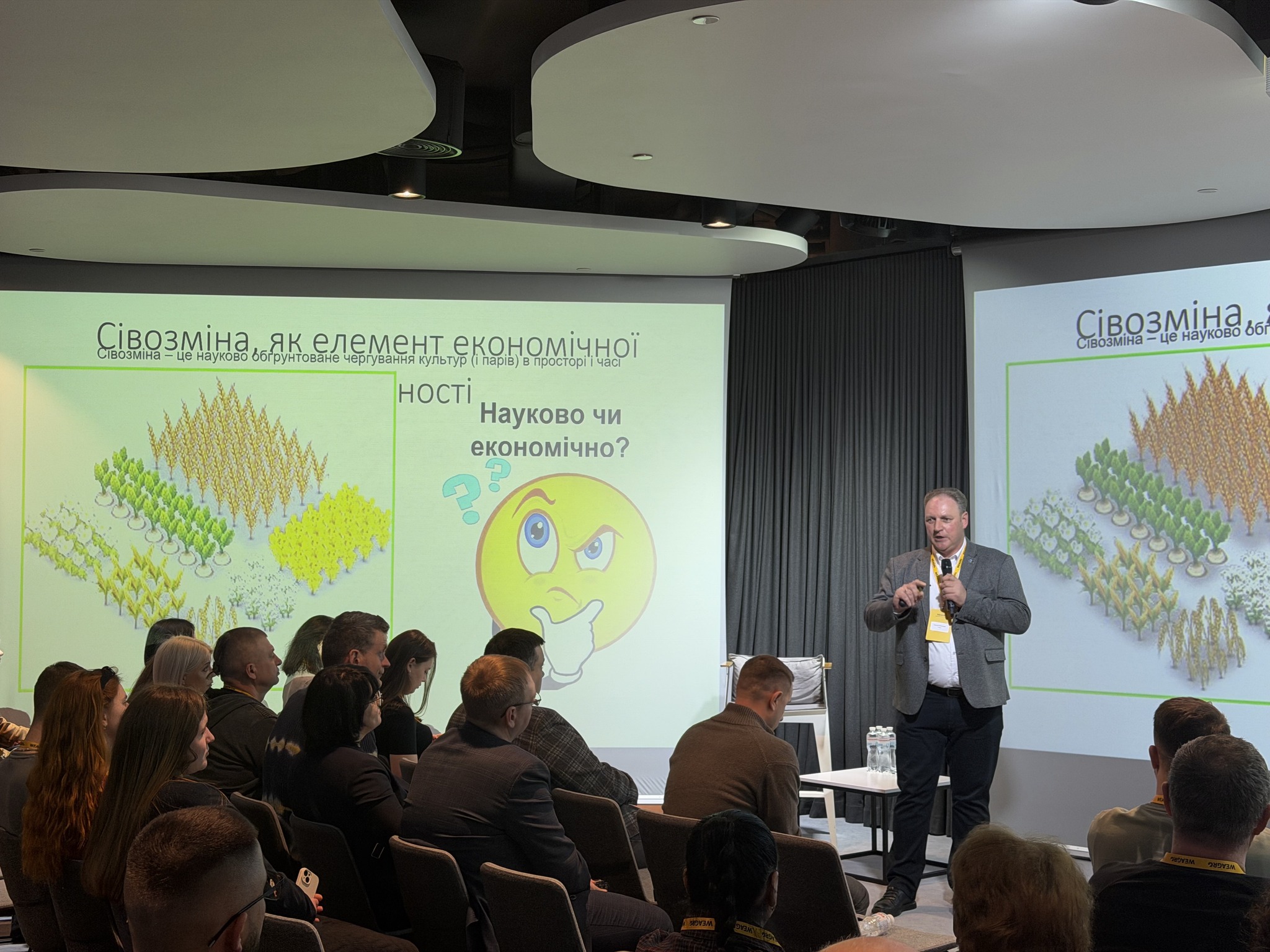
 During the "Agronomist as CEO of the field" conference by Activitis Education and WEAGRO, Oleksandr Khmeliuk explained how important it is to understand that every year differs from the previous one. What will bring income (the harvest, the price for the produce) are events that will happen in the future. Accordingly, funds not spent today are earned tomorrow. Therefore, even having a technological map, a budget, a production plan, you still need to respond to changes every day.
The agronomist's field of responsibility
 Among the agronomist's main competencies Oleksandr Khmeliuk includes planning technological maps, crop rotation, organising control of the execution of technological operations, monitoring fields and the state of crops, and necessarily the yield forecast.
Crop rotation. On a farm one needs to determine the balance between the scientifically substantiated and the economically substantiated concept of crop rotation; there must be a strategy. The crop-alternation plan should be developed for 3-5 years. The basis of a strategic plan is for the farmer to understand the logistics, the crop alternation, the soil tillage system, which machinery to buy, what the seed and protection system should be.
Control of operations in the field. It would seem this is quite routine work: understanding at what depth to sow, with what rate, when to sow. But it is precisely the timeliness of carrying out agro-operations that determines at least 50% of the potential of the future harvest. And the main thing: once tomorrow has come, it is impossible to change what was done yesterday. This is one of the main rules of agronomy — there is no going back.
Field monitoring. The main goal of monitoring should be, on the one hand, forecasting risks: that is, so that the technological map is flexible and can respond to the demands of the present, and it is also of great importance in terms of forecasting or assessing the crop's potential, which can change.
"For example, it was planned that we would harvest 8 t/ha of corn. I put this figure in the plan and, accordingly, created my technological map. But spring came, sowing, the reserves of moisture from the autumn-winter period were there, but there has been no rain for a month already. Accordingly, I need to correct the 8 t/ha to 6 or 5 t/ha and look at the budget and technological map, whether something can be not spent. Also, on the example of winter wheat, I have the most complex yield structure, many productivity elements, there must be a clear understanding of the organogenesis phases, and when, at what stage, which productivity element is formed. Accordingly, having come to the field, one needs to assess its potential: whether it still corresponds to the yield indicator set in the budget. Or perhaps 40 mm of rain fell, this coincided with the beginning of grain filling, and there is an understanding that there may be plus 3-4 c/ha. Therefore, the crop needs to be additionally fed, perhaps foliarly, because it has greater potential," explains Oleksandr Khmeliuk.
What place the agronomist holds in the enterprise management system
Today on farms one encounters very different criteria by which the agronomist is assessed. Sometimes there is a single assessment — simply a clean field, and few are interested in how this is achieved, how many herbicide treatments were done there and how many litres of crop protection products per hectare were applied. There is another, higher level, when a KPI is clearly set in the form of the profitability of each hectare, of the dollars or hryvnias invested in the technological map, then the main thing is not even the yield per hectare, but precisely the margin.
"But in the vast majority, probably, yield still determines the efficiency, level of qualification, experience, skills and knowledge of the agronomists on a farm today. Although this is not entirely correct — we need to reorient more towards profitability, towards margin. After all, no one in business is an altruist, everyone wants to earn a dollar per hectare, and accordingly the efficiency assessments should be the same."
The staffing problem. Where to find that very agronomist?
Growing an agronomist for a farm on your own is quite a difficult path and, most importantly, not a quick one, believes Oleksandr Khmeliuk. This can be done in at least 2-3 seasons.
"When we want to select a person, in my opinion, one needs to look at how many years they have worked in one place, how often they move from one job to another; I would pay more attention to experience, how long the person has been in the specialty. And secondly, probably the main thing — I would track the dynamics of how they grew in this direction. That is, it is advisable to pay attention to the specialist's growth dynamics. But it is difficult to do without a trial period, because there are human factors, there is character. The person needs to be given time to prove themselves, and the manager to take a closer look at the person," explains the specialist.
Most agri-holdings create various training courses, programmes, their own agro-schools where they can raise precisely such a needed agronomist. At the same time, the candidate should be motivated to stay at the enterprise, because many production sites are located in villages where there is no infrastructure or leisure at all, and young workers prefer cities. Therefore, the staffing problem exists, it is complex, and so far there is no simple way to solve it.
Source:agroportal.ua