2025
Corn hybrids are divided into grain and silage: each has its own features, adapted to a specific growing purpose.
Grain hybrids: for productivity and grain quality
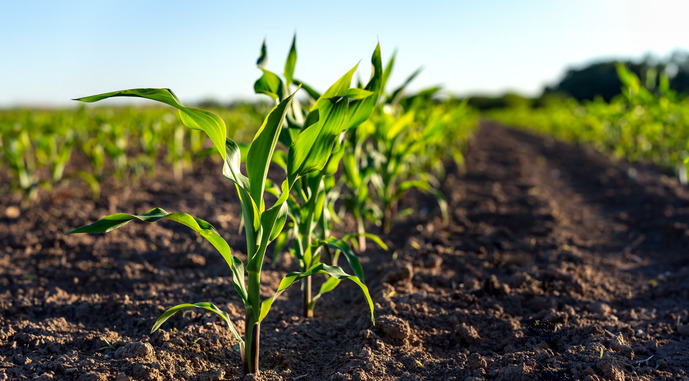 For a grain hybrid to be maximally effective, its grains must be strong, hard and glassy, in order to withstand transportation, cleaning and storage.
Such hybrids have:
- a strong stem resistant to lodging;
- a high cob position for harvesting convenience;
- grain that dries quickly on the plant.
These characteristics allow farmers to reduce drying costs, avoid grain damage and ensure a high test weight.
Why grain hybrids are not suitable for silage
An attempt to use a grain hybrid for silage almost always leads to a loss of feed quality.
1. Problems with starch. When a grain hybrid reaches maturity, the grains become hard and dry, while the stems still remain green. If you harvest the plant later, when the green mass has optimal moisture, the grain has already turned into "stone" — cows simply cannot fully digest it. Starch in this form is practically not assimilated, which reduces the feed's energy value.
2. A long storage period. To soften the grain, such silage needs to be kept for at least 6 months, which requires additional space, time and resources. Moreover, during long storage the loss of dry matter increases and the overall feed quality decreases.
3. Problems with fibre. In grain hybrids the stem is strong and woody, in order to hold the high cob. Because of this the fibre becomes hard to digest, and even with a high yield the overall nutritional value of the silage will be low.
Advantages of silage hybrids
Silage hybrids are created specifically to obtain quality feed that is easily assimilated by animals and ensures high milk yields.
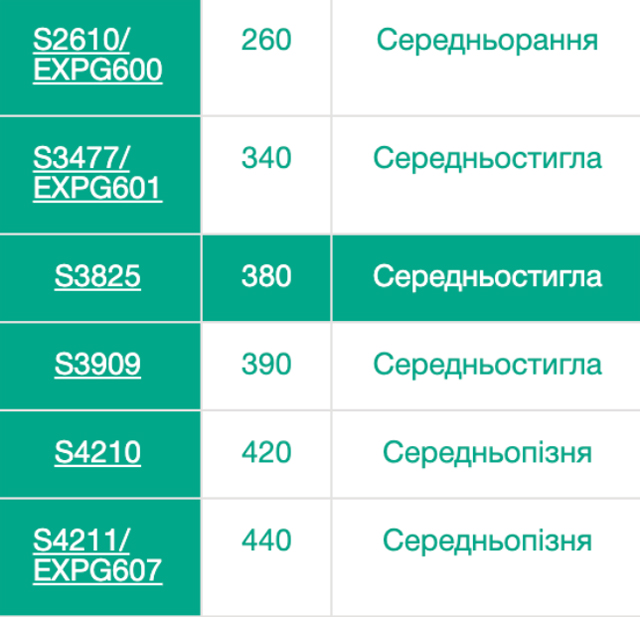 The advantage of silage corn hybrids is the balance between high yield and high nutritional value of the resulting silage. The main advantage of silage hybrids is additional leaves: above the cob there are 10-12 leaves. And also, unlike grain ones, they have a much wider leaf blade, the difference being 2-3 cm. Their key advantages: An optimal balance of starch and fibre — the grain remains soft and available for digestion. A longer harvesting period — the silage mass retains the necessary moisture for a longer time, which simplifies harvesting. Better fermentation — a high sugar content ensures stable fermentation without spoilage. Lower losses during storage — no long ripening in the pit is needed, the feed is ready faster. The UNIVERSEED silage hybrid line is represented by hybrids with different FAO:
S2610/EXPG600 (FAO 260). A mid-early hybrid with a dent grain type. Has high resistance to fusarium, fast moisture release and an early harvest date. Recommended for the zone of sufficient moistening.
S3477 (FAO 340). A mid-season silage hybrid with a dent grain type. Characterised by a high starch content in the grain. Recommended for growing, especially for northern regions, where hybrids with an FAO of 400 and higher do not receive enough solar energy for full ripening.
S3909 (FAO 390). A mid-season hybrid for silage purposes. Strict adherence to recommended densities. Has good drought tolerance, plasticity. Recommended for all growing zones.
S4210 (FAO 420). A mid-late hybrid for silage purposes. Has high potential. Recommended for sufficient and unstable moistening.
EXPG607 (FAO 420). A mid-late hybrid for silage purposes. High potential, tall, up to 14 leaves above the cob, good drought tolerance, high grain productivity, a wide harvesting window.