2025
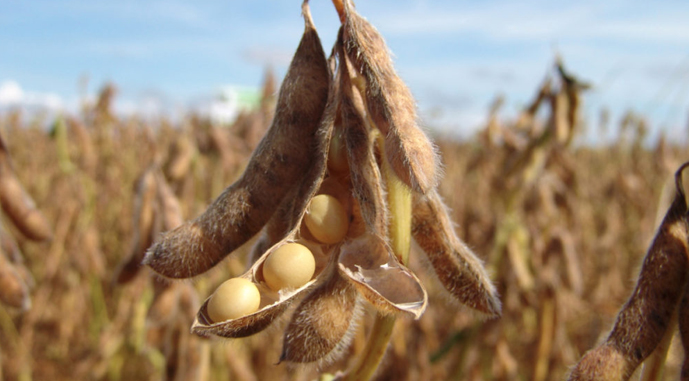 How to protect soybean crops in time and effectively in order to obtain the maximum harvest, and what to focus attention on — AgroPortal.ua enquired of the agri-technology development manager in the Central region of the company LNZ Group Serhii Ivaniuk.
"The initial stage of protecting soybean crops begins even before emergence. In this period the main task is to ensure a clean field even before the crop germinates. For this soil herbicides are applied, which work against weeds immediately after sowing."
According to him, one can cover a broad spectrum of both grass and dicotyledonous weeds by combining two products with different mechanisms of action. From the products the specialist recommends applying:
- Clutter (clomazone);
- Perun (prometryn);
- Matar (metribuzin);
- Double Try (metolachlor);
- Sora-Net (propisochlor).
 The application of herbicides in the correct phases guarantees less weed competition at the start and a better crop density.
"The next important stage — when the emergence has already appeared. In this period it is important to work in time with post-emergence herbicides — it is best to do this in the early phases of the weeds," notes Serhii Ivaniuk.
In this period for protection he recommends:
- against dicotyledons — Banten (bentazon);
- against dicotyledons — Clutter (clomazone);
- against grasses — Blade (clethodim) or Haruma (quizalofop-P-ethyl);
- for comprehensive control — Brox (imazamox).
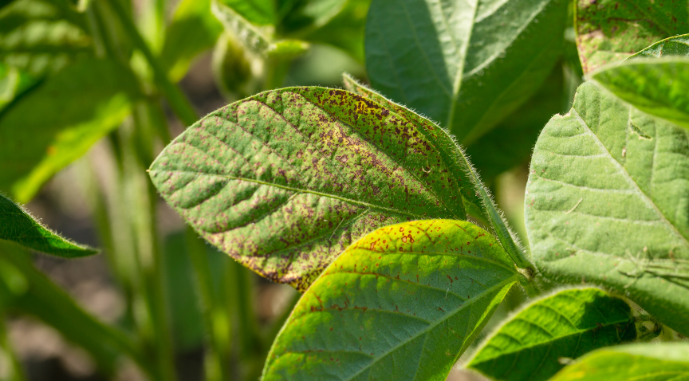
As for diseases, the greatest danger is posed by septoria, downy mildew, purple cercospora, sclerotinia and alternaria. The specialist draws attention to the fact that fungicide protection should definitely be carried out in the budding – beginning of flowering and bean filling phases. For this the following products will be effective: Split Duo (difenoconazole + azoxystrobin), Salto (thiophanate-methyl), Dot (cyproconazole + propiconazole), Ultralin (cymoxanil + azoxystrobin).
"Among pests, the greatest damage to soybean is caused by bugs, cutworms, the painted lady, the spider mite and capsid bugs, which damage the leaves and generative organs of the crop, affecting the quality and quantity of the harvest. During periods of mass colonisation they can become not only the cause of the loss of photosynthetic activity (and subsequently of the harvest), but also carriers of viruses and mycoplasma. Based on the results of the inspection of the crops and the species of pests detected, the insecticides Altron, Atik, Bombardier Duo, Kairos, Octant Turbo, Mirald should be applied."
He adds that one of the factors of the decrease in soybean productivity that domestic farmers face is the damage to plants by the spider mite, with the numerous colonisation of which one can lose about 50% of the harvest. Its harmful influence lies in promoting an increase in the transpiration coefficient, because of which relatively quick drying-out of the plants occurs, especially under dry conditions. The intensity of photosynthesis also decreases because of the mite secreting enzymes that break down chlorophyll. Favourable conditions for the development and mass increase of the spider mite population in soybean crops are low air humidity and high temperature.
For the fight against the spider mite on soybean, in the range of protection products from the DEFENDA brand there is provision for the use of the highly selective contact acaricide Mirald (fenpyroximate, 50 g/l) 0.7-1.15 l/ha, which completely destroys all mobile stages of the mite's development and exhibits a high ovicidal action. This is due to the properties of fenpyroximate, which disrupts the processes of oxidative phosphorylation, which leads to the complete cessation of the vital processes and the quick death of the pests.
The use of the acaricide Mirald provides a "knockout" effect on all stages of the plant-eating mites with a subsequent long action, which makes it possible to maximally protect the harvest.