2025
From the beginning of sowing the crop, every day in the field turns into a real battle for the harvest. This year's season promises new challenges for sunflower — from early damage by the sand darkling beetle to the insidious white mould of the heads. Valentyn Vydybura, agri-technology development manager for the Central region of "LNZ Group", related the optimal scheme of protecting sunflower from the first leaf to the ripe heads and the expected problems in the fields in the 2025 season.
 The first sunflower treatment — herbicide protection
The protection of sunflower begins with seed treatment. For the most part the treatment takes place at the seed plant and it arrives at the customer's already treated. Seed can be ordered both with only fungicide treatment and together with an insecticidal seed treatment and with a complex of microelements.
If there is still a need to additionally treat the sunflower seed material with an insecticidal seed treatment, then in the portfolio of the DEFENDA brand there are such products as Latina (clothianidin, 600 g/l) at a rate of 4.5-7 l/t or Metaksa (thiamethoxam, 350 g/l) at a rate of 6-10 l/t. Treatment with these products protects the seed and the crop's emergence from such pests as: wireworms, false wireworms, darkling beetles, aphids, weevils.
Traditionally the first stage of sunflower protection is the application of pre-emergence herbicides against dicotyledonous and grass weeds. There are several options:
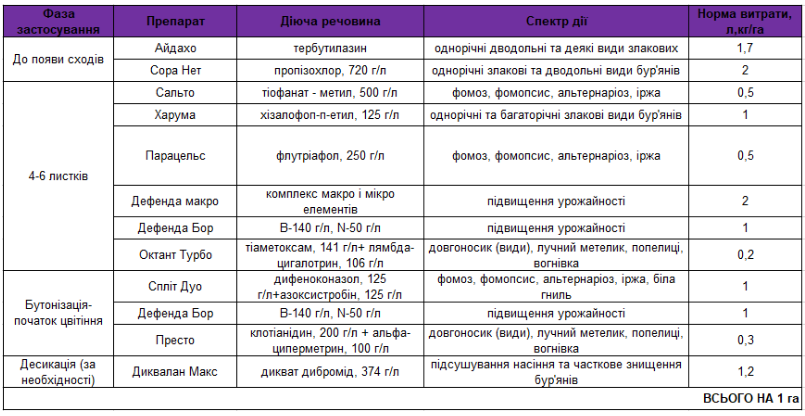
One of the most effective is the scheme of soil protection with the active ingredient terbuthylazine, 500 g/l, (Idaho), at a rate of 1.5-2.5 l/ha and propisochlor, 720 g/l (Sora Net), at a rate of 2.0-3.0 l/ha.
The use of one herbicide is possible, which combines these two active ingredients, such as Starlent (propisochlor, 360 g/l + terbuthylazine, 190 g/l), at a rate of 3.8-4.5 l/ha).
Also often used is the combination of terbuthylazine and metolachlor. In the DEFENDA range these are the herbicides Double Try (S-metolachlor, 960 g/l) and Idaho (terbuthylazine, 500 g/l).
One can apply a herbicide that already includes these active ingredients — Novante (S-metolachlor, 312.5 g/l + terbuthylazine, 187.5 g/l) at a rate of 3.5-4.5 l/ha.
Protection in the 4-6 leaves phase
Herbicide protection
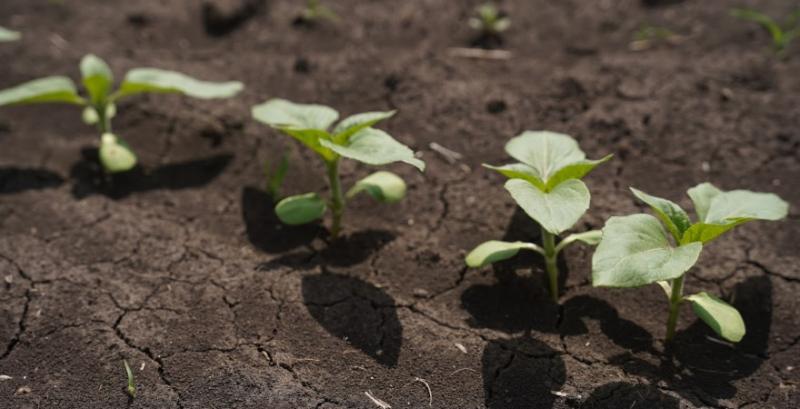 The next stage of protection in most cases falls on the 4-6 true leaves phase. The treatment can be carried out with the herbicides Blade (clethodim, 120 g/l) at a rate of 1.4-1.8 l/ha or Haruma (quizalofop-P-ethyl, 125 g/l) at a rate of 0.6-1.2 l/ha.
"If your sunflower is resistant to tribenuron-methyl, then one can use the herbicide Sheriff (tribenuron-methyl, 750 g/kg) at a rate of 0.030-0.050 kg/ha. If resistant to the imidazolinone chemical group, then one can use the herbicide Impreza (imazamox, 33 g/l + imazapyr 15 g/l), at a rate of 1-1.2 l/ha in the sunflower phase from 2 to 4 true leaves or Brox (imazamox, 40 g/l), at a rate of 1-1.2 l/ha in the 4-6 leaves phase. These products will remove the problematic grass and dicotyledonous weeds," says Valentyn Vydybura.
Protection against diseases
As for fungicide protection, one can select a multitude of options, depending on the spectrum of diseases present, and also the wide variety of active ingredients.
"Farmers often apply in this sunflower phase such active ingredients as carbendazim, thiophanate-methyl, flutriafol. Therefore one can apply the following combinations: Absolut (carbendazim, 500 g/l), at a rate of 0.5 l/ha with the addition of Paracelsus (flutriafol, 250 g/l) at a rate of 0.5 l/ha or Salto (thiophanate-methyl, 500 g/l) at a rate of 0.5 l/ha with the addition of Paracelsus (flutriafol, 250 g/l) at a rate of 0.5 l/ha," says the specialist.
He adds that against septoria the fungicide DOT (cyproconazole, 80 g/l + propiconazole, 250 g/l) at a rate of 0.5 l/ha is effective. It will also protect the sunflower from rust and alternaria.
 Also in this phase, in cold, wet spring weather, manifestations of downy mildew may appear on sunflower. With this disease, the active ingredients described above will already not be effective. Therefore it is better to select other products. For example, the fungicide Ultralin (cymoxanil, 300 g/l + azoxystrobin, 250 g/l) at a rate of 0.3-0.5 kg/ha. It works effectively against downy mildew, alternaria, white and grey mould of sunflower.
Sunflower pests in the 4-6 leaves phase
At this stage, one should not forget about protecting the sunflower crops from pests either. Valentyn Vydybura emphasises that the choice of insecticide will also depend on the tasks that need to be solved in the field.
One can consider the following contact-systemic action insecticides: Bombardier Duo (imidacloprid, 300 g/l + lambda-cyhalothrin, 100 g/l) at a rate of 0.15-0.25 l/ha, Presto (clothianidin, 200 g/l + lambda-cyhalothrin, 50 g/l), at a rate of 0.3-0.4 l/ha, and Octant Turbo (thiamethoxam, 141 g/l + lambda-cyhalothrin, 106 g/l) at a rate of 0.2-0.25 l/ha.
He adds that in this period the sunflower can be fed with micro- and macroelements. But here one should weigh whether the plant is under stress, whether it is necessary to improve the development of the root system or of the leaf surface, to apply a mono-product or a complex one, and so on. For each of the problems the variety of products here is even greater than in the pesticide group.
"In this development phase one can apply DEFENDA Macro at a rate of 2 l/ha. If additionally the plant is under stress from possible frosts or herbicide stress, then we add the product DEFENDA Amino at a rate of 0.5-1 l/ha. The product contains a high concentration of amino acids of plant origin, with a high anti-stress and regenerative action on the plant," relates the specialist.
The budding phase — the beginning of flowering
According to Valentyn Vydybura's observations, the next period of sunflower protection falls approximately on the budding phase — the beginning of flowering. Herbicide protection is no longer carried out, but the fungicide protection should be approached responsibly.
"In this period signs of damage by phoma, phomopsis, alternaria, rust and other diseases may appear on sunflower," he notes.
He recommends applying the fungicide Split Duo (difenoconazole, 125 g/l + azoxystrobin, 125 g/l) at a rate of 0.5-1.0 l/ha. Relevant in this period will be the application of a high concentration of boron. For example, one can apply the product DEFENDA Boron (B-14%, N-6%) at a rate of up to 2 l/ha. In the presence of pests one can use products analogous to those in the previous development phase.
"I would like to emphasise that this is only an approximate protection system. But each case I advise approaching individually," noted Valentyn Vydybura.
Sunflower desiccation
The final stage in growing sunflower is desiccation. There are many disputes about whether it is worth carrying out. Valentyn Vydybura says that this agricultural operation is worth carrying out if:
- the drying-out of the plants is uneven in nature and proceeds more slowly than desired;
- wet weather leads to yield losses and a decrease in its quality, so one wants to harvest it as early as possible; there are diseases on the sunflower: phoma, phomopsis, various rots, which leads to a significant decrease in yield and seed quality, the oil content in the products decreases;
- the field at the moment of harvesting is clogged with weeds, which leads to the clogging of the combine's working parts and an increase in the seed moisture;
- the plants dry in the field for a long time, and note ever greater losses from birds and other animals;
- when using intensive growing technology, irrigation (fertigation), a plant protection system, when the preservation of the plants in a green state for a long time is observed;
- you do not manage to harvest the sunflower for the sowing of the next crop, for example, winter wheat, within the optimal timeframe — one can speed up the sunflower harvesting with the help of desiccation.
The optimal time for carrying out desiccation is the time when the seed moisture is 20-25% and the plants are in the stage of physiological ripeness. After reaching lemon ripeness desiccation becomes necessary at a seed moisture of about 30%. For the application of desiccants a mean daily temperature of +13-14 °C should be chosen, when their action is most effective.
The choice of desiccant depends on the aim of the treatment. If it is necessary to dry the crop down to the standard moisture, it is recommended to use the desiccant Diquavan Max (diquat dibromide, 374 g/l) from the DEFENDA brand. In the case when before harvesting there are weeds in the field and the plant moisture exceeds 30%, it is better to opt for products based on glyphosate, such as Napalm (isopropylamine salt of glyphosate, 480 g/l (360 g/l in acid equivalent)) or Napalm Super (potassium salt of glyphosate 663 g/l (540 g/l in acid equivalent)). Diquat is the fastest-acting desiccant and provides an effect within 4-7 days, whereas glyphosates require 12-14 days to achieve the maximum result.
"If the sunflower ripens evenly, the field is clean of weeds and not affected by diseases, the seed moisture at harvesting is normal, if you manage to prepare the field for the next crop, then it is not obligatory to do the desiccation," sums up the specialist.
What to expect in the sunflower fields in the 2025 season?
Valentyn Vydybura notes that it is difficult to make a forecast of which diseases will dominate in the sunflower crops in the 2025 season. But he says that their number is increasing, since the crop every year occupies the lion's share of the total areas. Another factor in the spread of diseases is the tendency towards a reduction of deep tillage. Crop residues are preserved on the soil surface and preserve the pathogens of diseases, which successfully overwinter in warm and wet winters.
"From the experience of previous years I say that sunflower can be affected by septoria, downy mildew, alternaria, since in the crop rotation the crop occupies a very large share," adds the specialist.
Diseases in the crops can appear practically immediately. Sunflower crops that are sown into insufficiently warmed soil in cool weather with wet nights can be affected by downy mildew.
The second common disease in sunflower crops is septoria. In some sources one can read that the disease develops in the second half of summer or after flowering. But in recent years manifestations of septoria can be seen even on the emergence. Likewise the pathogens of this disease successfully overwinter on crop residues in the form of pycnidia.
"Also I would like to draw attention to the head form of sclerotinia or white mould. This disease is dangerous in that it can spread with frequent precipitation, or with the neglect of the fight against pests. Thus, for example, in 2024 favourable conditions formed for the development of the caterpillars of various species of cutworms, which gnawed holes in the heads, through which moisture got in and where this disease developed," notes the expert.
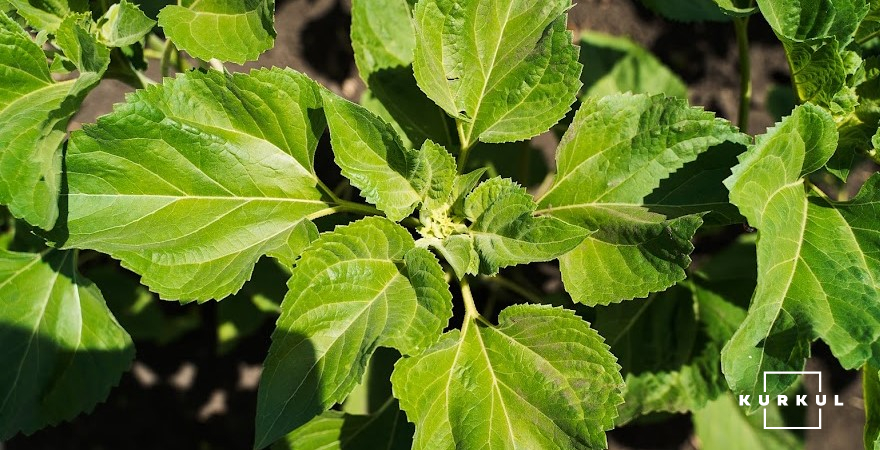 He adds that these are only a few diseases that can affect sunflower in the 2025 season. For example, if such conditions form that, conditionally, in the budding phase downpours pass, then there is a high probability of the manifestation of phoma or phomopsis on the sunflower. These diseases can damage not only the leaf surface, but also the stem, which in the case of neglecting the disease can lead to lodging of the crops.
He also emphasises that quite often diseases are confused with each other by the similar manifestation of symptoms. Thus, for example, the basal form of sclerotinia can be confused with verticillium wilt and charcoal rot, the stem form of sclerotinia with phomopsis, phomopsis with phoma and so on. And therefore in the identification of diseases one also relies on the weather conditions that formed in different development phases of the crop. In particular, favourable factors for the development of the diseases are:
- septoria — rainy and warm (15-30 °C) weather, in particular frequent moistening during flowering or after (rain, fog, heavy dew);
- alternaria — precipitation after sowing, then warm wet weather;
- downy mildew — cool rainy weather (12-14 °C), the presence of droplet moisture in the period from 3 to 15 days after sowing;
- powdery mildew — the alternation of warm and dry weather with moderately moist;
- phomopsis — frequent downpours; phoma — frequent thunderstorm rains, droplet moisture, soil moisture above 60%;
- sclerotinia — increased soil moisture in the period before flowering, in particular prolonged wet growing conditions: rain, fog, dew and a temperature of 20-30 °C;
- white mould of the heads — moisture and a lowered air temperature at the time of seed germination and browning of the heads;
- verticillium wilt — water stress (factors: sandy soil, heat and drought);
- charcoal rot — dry and hot weather, in particular a high soil temperature above 25-30 °C.
Sunflower has not yet been sown, but the darkling beetle is already waiting
Growing sunflower is constantly accompanied by the risk of damage by pests throughout the entire development period of the plants, starting from sowing. It is important to understand that the harmfulness depends not so much on the type or name of the pest as on its quantity in a specific period of time.
At the initial stage of sunflower development, when the economic threshold of harmfulness (ETH) is exceeded, various species of pests can cause damage to the crop. Among them especially dangerous are various species of click beetles. The most widespread species are the striped and the steppe click beetle.
"These phytophages are the main pests of sunflower emergence, they damage the seed that is germinating, gnaw through the seedlings, roots or gnaw out deep pits in them," says Valentyn Vydybura.
A no less harmful subspecies of click beetles is the wireworms, which in spring rise into the upper soil layer (1–8 cm), attack the swollen seed, eating out the embryo, and later switch to the plant emergence, the roots and the underground part of the stem of winter crops.
The false wireworms — the larvae of black beetles — cause damage too.
These pests are more often found in the steppe and forest-steppe zones of Ukraine. The feature of their life activity is that both the larvae and the beetles cause damage, eating up the young emergence.
"One can already say with confidence that this year we will observe the presence of the sand darkling beetle in the sunflower fields. Since on 20-25 March it was recorded in the winter wheat fields in the Kirovohrad region," shared the expert.
During the sunflower growing season the greatest damage to the leaves and heads can be caused by the caterpillars of various pest insects.
Among them the most widespread are the caterpillars of the meadow moth, the cotton bollworm and other species of cutworms. Among other dangerous sunflower pests, not the least place is occupied by the sucking insects — aphids and thrips. Their development is especially promoted by dry and hot weather.
"With significant damage the losses can reach 70%," warns Valentyn Vydybura. To control the number of all the above-mentioned pests, specialists recommend the timely application of insecticides in accordance with the recommended rates and taking into account the economic thresholds of harmfulness.