31October
2025
2025
During all field work, in particular tillage, minimal parameters of tyre pressure on the soil should be observed in order to avoid its over-compaction. This is reported by the agro department of LNZ Group.
It is noted that over-compacted soil leads to:
- Disruption of the circulation of water and air within the soil layers.
- Disruption of thermoregulation.
- Reduction of water permeability.
- Reduction of the number and size of pores in the soil. And as a consequence — suppression and disruption of plant root growth, because the root system is mostly formed incorrectly and is often underdeveloped.
"It should be remembered that light sandy soils are prone to greater compaction than heavier ones. In addition, reducing pressure on the soil can be helped by installing dual or wide tyres, reducing or removing ballast from the tractor," the specialists add.
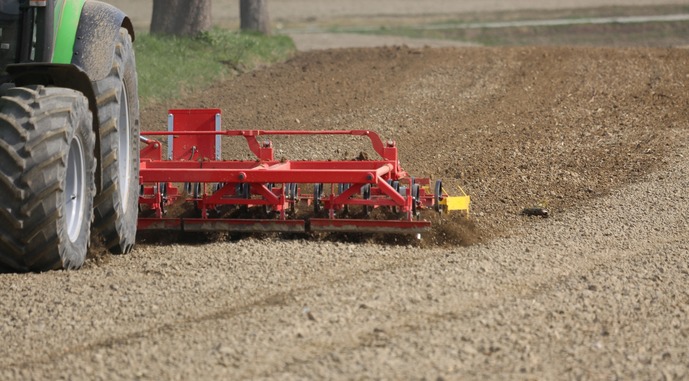 According to their recommendations, tillage should be carried out when the soil is in physical ripeness (this is a certain interval of soil moisture at which, during tillage, it crumbles well without much effort and does not stick to tillage implements). Working ripe soil makes it possible to obtain the best quality at the lowest energy costs.
"For clay soils, physical ripeness is in a fairly narrow moisture interval — 50-65% of full moisture capacity (FMC). For lighter (loamy and sandy loam) ones this interval is much wider — 40-70% FMC. Well-structured soils with a high humus content have a wider interval of optimal moisture for quality tillage. This also has great practical significance, since different soils ripen unequally. Thus, in spring sandy and sandy loam soils will ripen 5-7 days earlier than loamy ones, and 7-10 days earlier than clay ones," the specialists summed up.