2026
Corn is a crop with a long herbicide-critical period. In the initial stages of organogenesis (from emergence to the 8-10 leaf phase), the crops have low competitive ability, which is due to the slow rate of vegetative mass build-up compared with segetal (weed) vegetation.
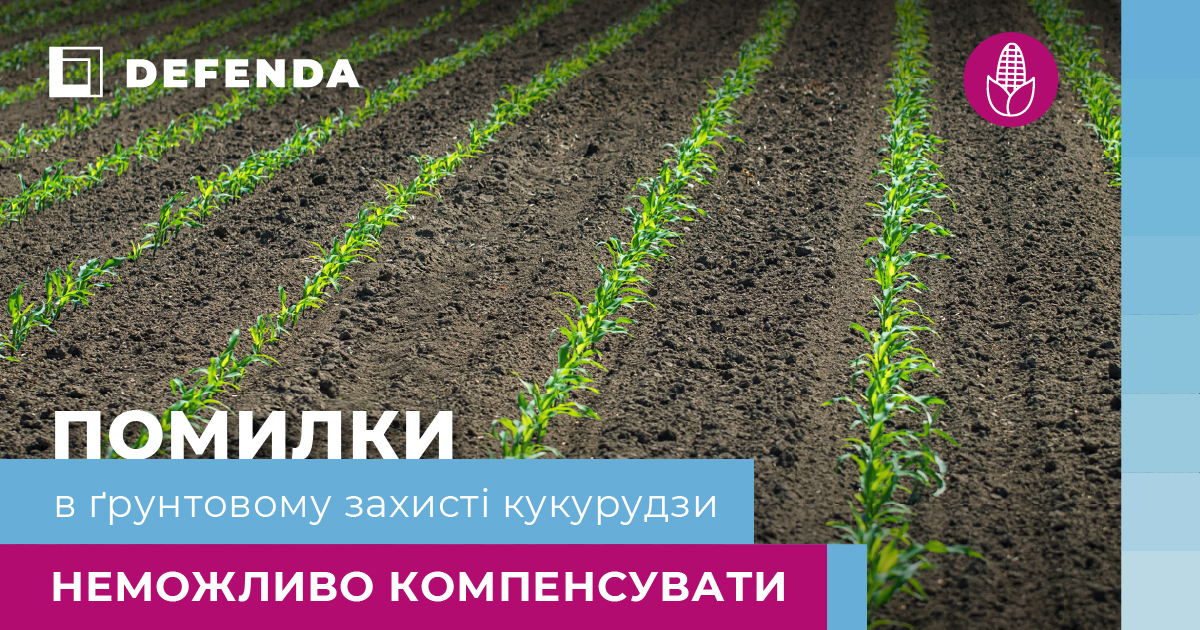 The critical competition period covers the phases VE (emergence) – V10 (10 leaves). During this interval the potential yield is laid down:
- Phase V3-V5: formation of the number of grain rows in the cob.
- Phase V6-V8: determination of the number of grains in a row.
Any stress caused by weed infestation in these phases leads to an irreversible reduction in productivity that cannot be compensated.
Weeds act as aggressive consumers of vital resources, outpacing the crop in the rate of assimilation, which is accompanied by:
Water deficit: the transpiration coefficient of most weeds (fat hen — 800 ml/g of dry matter, pigweed — 1200 ml/g) is from 600-1200 ml of water per 1 g of dry matter, which is 2-3 times higher than the needs of corn (350 ml/g of dry matter). This creates an artificial drought in the root-containing soil layer.
NPK assimilation: Weeds consume nutrients much more intensively than corn, especially at the beginning of vegetation. The volume of NPK removal depends on the type of weeds and the degree of field infestation. On average, during the first 30 days of corn growth, weeds can absorb:
- Nitrogen: about 60 kg/ha.
- Phosphorus: about 10 kg/ha.
- Potassium: about 60 kg/ha.
- This consumption is 7-10 times higher than the needs of the corn itself in the same period.
The harmfulness of weeds manifests itself even before direct physical competition, through mechanisms of remote influence such as shading and allelopathy.
- The "shade avoidance" reaction: A change in the ratio of red to far-red light (R:FR) in the spectrum reflected from the weeds' leaves is perceived by the corn's phytochromes as a danger signal. The plant redirects energy to stem elongation instead of root development, which makes it weak and prone to lodging.
- Allelopathy: The release by the weeds' root system of toxic metabolites (colines) which suppress cell division in the corn's meristem, blocking its growth at the hormonal level.
Some weeds (for example, fat hen or knotweed) release phenolic compounds that inhibit cell division in the corn's roots. Even if there is enough moisture, the seed germinates slowly or unevenly.
Toxins from foxtail or pigweed can penetrate through the corn's root system and disrupt chlorophyll synthesis. The leaves become pale, and the process of biomass accumulation slows down.
Even if you destroy the weeds with a herbicide, their residues in the soil can still release toxins for several weeks. Therefore, the best strategy is to control weeds before they build up a large vegetative mass.
Weed infestation of corn crops in the early stages of vegetation leads to yield losses of from 15% to 70% depending on the species composition and density of the weeds.
The protection strategy should be based on ensuring the complete cleanliness of the crops until the 8-10 leaf phase, which is the key to realising the hybrid's genetic potential and obtaining consistently high yield indicators.
The DEFENDA brand's technological concept envisages creating a controlled, clean start for the crop through the use of modern soil herbicides.
After application before crop emergence, the product forms an active herbicide layer in the upper soil horizon. During weed germination the active ingredient penetrates into the seedling and blocks its development in the early stages.
The DEFENDA brand portfolio uses proven active ingredients, in particular:
- acetochlor — Sahara, Sahara Super;
- S-metolachlor — Literon;
- terbuthylazine — Idaho;
- propisochlor — Sora-Net;
- metolachlor — Double Try.
Combined formulations make it possible to effectively control both grass and broadleaf weed species.
- S-metolachlor + terbuthylazine — Novante;
- propisochlor + terbuthylazine — Starlent.
Technological advantages of the system
- Maximum control of the first wave of weeds. The field remains clean during the critical period of corn development.
- Preservation of productive moisture. Under conditions of an unstable spring this is one of the key factors in yield formation.
- Flexibility in technology. The DEFENDA brand's soil protection easily integrates into classic and minimum tillage systems.
- Reduction of the load on post-emergence treatments. With quality initial control, the need for post-emergence application is significantly reduced.
For the full realisation of the potential of the DEFENDA brand soil herbicides it is important to:
- ensure a level seedbed;
- control the depth of seed placement;
- take into account the soil type and humus content;
- be guided by the availability of moisture or the precipitation forecast.
Economic feasibility
Farm practice shows: preserving even 0.5-1.0 t/ha of yield fully compensates for the investment in soil protection. At the same time, the risk of losing potential under drought conditions is reduced, which is especially relevant for the central and southern regions of Ukraine.
The integrated DEFENDA approach
The DEFENDA brand views soil protection not as a separate operation, but as part of a comprehensive system:
- the right hybrid choice;
- balanced nutrition;
- weed monitoring;
- if necessary — post-emergence backup solutions.
This approach allows farms to minimise risks and stabilise yields under various weather scenarios. DEFENDA soil herbicides are a technology of a managed start for corn. With proper integration into the protection system, they ensure stable weed control, moisture preservation and the formation of uniform, competitive crops.
Volodymyr Baida, agronomist of Ukragroprotect LLC