2026
Rapeseed stays in the field for almost a year. For eleven months it has to get through drought, heat, frost and whatever else the weather throws at it along the way. And the weather no longer looks anything like the textbook agronomy describes.
 Dry autumns, moisture shortage at sowing, mild winters, early spring regrowth followed by late frosts and summer heat – all of this stopped being a feature of southern Ukraine alone a long time ago.
Most regions of Ukraine now follow the same scenario. And that means the rules of rapeseed protection have changed too.
«6 t/ha of rapeseed is a meaningless figure»
Just a few years ago, farmers choosing a hybrid looked at the yield potential on the label. They read about record 6 t/ha on other farms and wanted the same result in their own fields. But that figure only shows what a hybrid can do under ideal conditions. Before it reaches harvest, the plant has to pass far too many tests in a row, and none of them will be ideal.
«First you need uniform emergence despite a moisture deficit. Then the crop has to get through autumn growth, overwinter, withstand spring frosts and, in summer, high temperatures and uneven rainfall,» lists Artem Yuriev, rapeseed product manager at Limagrain Ukraine LLC.
Which traits are key now? First, the ability to survive winter frosts, drought and temperature swings without sharp dips. Second, resistance to disease pressure such as verticillium wilt, phoma stem canker, sclerotinia, TuYV virus and, in some regions, clubroot. And third, pod shatter resistance, since weather anomalies during ripening increasingly take part of the yield before the combine even enters the field.
Overgrowth is a separate issue. A long warm autumn makes rapeseed lift its growing point, and it is overgrown rapeseed that copes worst with winter stress, especially when there is no snow cover. Here genetics works hand in hand with sowing dates.
So which hybrids should you choose?
«The winners today are plastic hybrids – those that actively build leaf mass in autumn but are not prone to stretching the root collar and respond well to growth regulators,» says Artem Yuriev.
For example, if a farm is looking for the most versatile product that performs consistently across different soil and climate conditions, LG Adeline is the better choice. In fields where clubroot has occurred before, primarily in the west of the country, LG Scorpion will be more appropriate.
«But a hybrid, however resistant, is only half of the equation. The other half is played out in the first weeks after sowing, when it is no longer breeding but crop protection technology that fights for the plant,» the specialist notes.
Why does seed treatment decide everything in a drought?
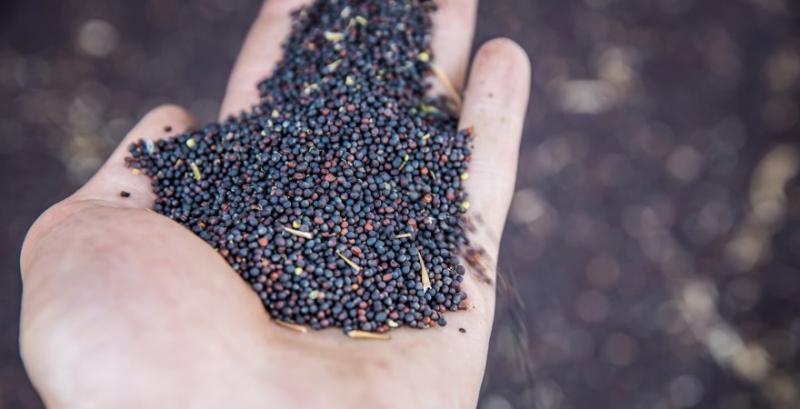 Choosing the right hybrid is only the first step. The second is building a protection programme that accompanies the plant from its first days in the soil. If seed lies in dry soil for weeks waiting for rain, it is in contact with pathogens the whole time.
If, on the contrary, it pours after sowing, the risk shifts towards root rots and seed moulds even before emergence.
«That is why a seed treatment has to cover both scenarios at once and protect the plant against soil-borne infection pressure, whatever the start of autumn turns out to be. It is the first line of defence, and it works before the agronomist even sees the first seedlings,» says Rostyslav Kyryliuk, agricultural technology development manager at LNZ Group.
By choosing exclusive French-bred Limagrain rapeseed hybrids from LNZ, you get seed with effective treatments that provide maximum protection against harmful organisms at the early stages of growth.
Diseases and pests: insecticide and fungicide protection of rapeseed. Treated seed, however, protects the plant only at the start. Later, throughout the autumn, diseases and pests come into play, and warm weather only helps them. One of the latest trends is a warm autumn, which extends the active season for both diseases and pests. Rostyslav Kyryliuk says disease activity is already noticeable in central Ukraine.
«Among diseases, the biggest concerns are phoma, Fusarium root rots, Alternaria and seed moulds. If phoma shows up on the rapeseed rosette year after year, it is a direct signal that the growth regulator application at the 4–6 leaf stage must not be postponed,» the company representative stresses.
Among pests, the more aggressive ones are flea beetles, larvae of wireworms, false wireworms and cabbage root fly. From his own practice, Rostyslav Kyryliuk has settled on the following protection scheme:
- Octant Turbo (thiamethoxam 141 g/l + lambda-cyhalothrin 106 g/l), 0.2–0.25 l/ha at emergence – covers the main range of pests;
- Tviks (chlorpyrifos 500 g/l + cypermethrin 50 g/l), 1.0–1.1 l/ha – where hidden pests are also present. Thanks to its fumigant action, the insecticide reaches even those hiding in the soil;
- Atik Max (acetamiprid 300 g/l), 0.1–0.2 l/ha – for a targeted strike on flea beetles and bugs;
- Ravak (metaldehyde 60 g/kg), 2–3 kg/ha, granules between the rows – separately against slugs, which thrive in a warm, wet autumn.
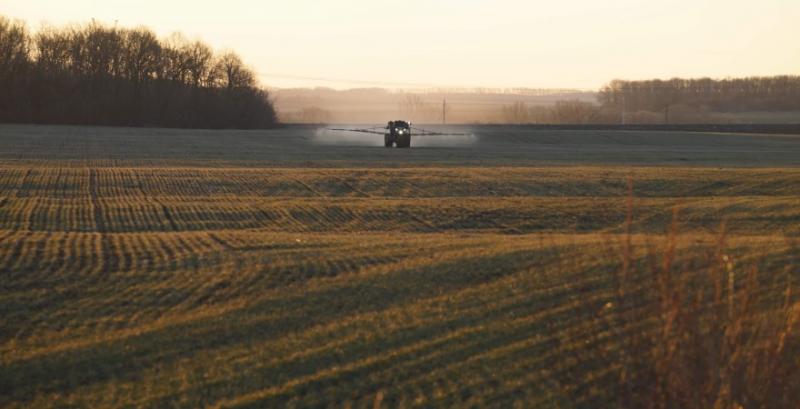 First and second herbicide applications in drought conditions. Alongside diseases and pests, there is another rival to keep under control – weeds. And here the problem is not a pathogen or an insect, but moisture.
«The paradox is that any soil-applied herbicide depends on moisture in the topsoil, and without it the active ingredient simply does not activate,» explains Rostyslav Kyryliuk.
Before crop emergence, the specialist recommends applying the herbicide Klatter (clomazone 480 g/l), 0.15–0.20 l/ha. To broaden the spectrum and extend the protective screen while the product waits for rain, Sora-Net (propisochlor 720 g/l, 2.0–3.0 l/ha) is added to it. An interesting question is whether a second herbicide application is needed in autumn.
«There is no clear-cut recommendation here. The decision is made on the actual weed infestation of a specific field, not by a template. If the pre-emergence block worked cleanly, a second treatment is just an extra cost with no effect. If a second flush of weeds appears after it, then a correction is justified,» the LNZ Group representative stresses.
Protecting late-sown rapeseed
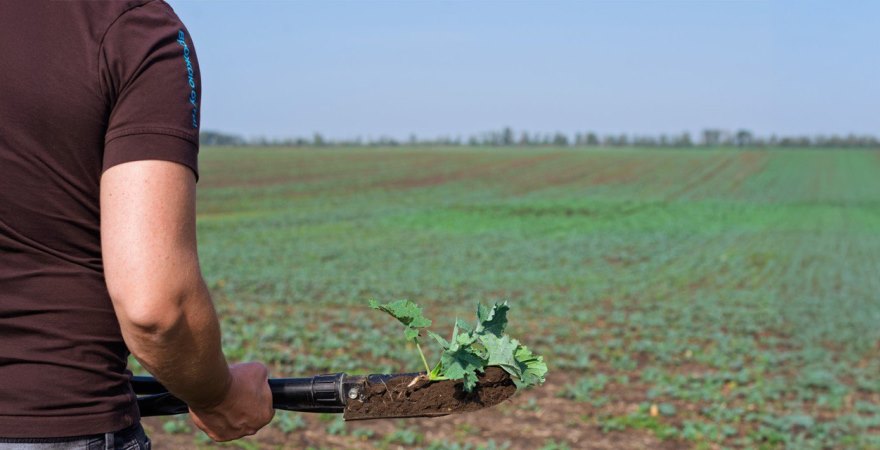 Late sowing leaves plants little time to form a rosette before winter, so any additional competition from weeds or diseases hits overwintering much harder. Rostyslav Kyryliuk says there is no point in stretching the classic scheme across growth stages. A compact block of three steps, condensed in time, works better:
- first – soil-applied protection immediately after sowing;
- second – Octant Turbo or Tviks at emergence against pests; third – a fungicide with growth-regulating action at the 4–6 leaf stage, which both restrains overgrowth and controls phoma. This concentrates protection in a narrow window while the plant is most responsive to intervention.
- This third step deserves special attention – its role is most often underestimated.
«In a warm, long autumn rapeseed does not stop growing and lifts its growing point, and overgrown plants cope worse with winter temperature swings,» stresses Rostyslav Kyryliuk.
He recommends triazole fungicides with a growth-regulating effect – Taler, Taler Max, Kamzol, Kamzol Turbo, which work in two directions at once: they cure disease and restrain growth. Topal (trinexapac-ethyl 250 g/l), 0.4–0.6 l/ha, has a purely regulatory function: it blocks gibberellin synthesis, so internodes become shorter, the stem thicker and the root system develops more strongly.
«These two functions work best as a pair – Topal together with Taler/Taler Max or Kamzol/Kamzol Turbo at the 4–6 leaf stage: the plant gets both protection and physical preparation for winter at once,» the specialist adds.
A snowless winter can harm rapeseed
All steps, from seed treatment to the fungicide-regulator, serve one goal – preparing the plant for winter. But, once again, winter today does not follow the textbook rules.
«It might seem that a winter without frosts is a relief. In fact, it is the other way round: without steady frosts the plant keeps growing slowly, using up the reserves accumulated in autumn, and some pests and pathogens do not stop developing at all,» says Rostyslav Kyryliuk.
Sharp swings between thaws and short frosts often do more harm than a stable cold winter. That is why everything described above – a well-chosen hybrid and Topal paired with Taler Max or Kamzol Turbo – serves one goal: to form a plant with short internodes, strong roots and a low-set growing point.
«Such a plant gets through an unstable winter much more calmly than stretched, overgrown rapeseed,» the specialist adds.
Ultimately, both the choice of hybrid and the protection scheme answer the same question: how to make sure the plant reaches harvest in good condition, whatever the next season turns out to be. There is no longer a universal formula – there is a specific field, the weather and decisions that have to be made anew every year.
Source: kurkul.com