2025
The significant fluctuation of temperatures, the reduction of the mean annual amount of precipitation by 100 mm, which over the years will be even smaller, have led to the shift of the natural and climatic zones north by approximately 200 km. Experts do not undertake to make long-term optimistic forecasts, on the contrary, they speak of a further rise in the mean annual temperature from 1-2 °C to 6-7 °C by the end of the century.
 Practices that will help retain moisture in the soil
According to data from the World Meteorological Association, as of 5 February Ukraine has high moisture reserves in the metre soil layer only in an insignificant part of the Kyiv and Cherkasy regions. In the rest of the territories they are quite low.
The head of the LNZ Group agro department Oleksandr Khmeliuk notes that for maize, sunflower and soybean the peak of moisture consumption will fall on mid-July – mid-August. By this time little moisture remains in the soil from the autumn-winter reserves, so the yield will for the most part depend on the amount and nature of the precipitation during the plant growing period. The reserves of the autumn-winter period amount to 30-40% of the total need of these crops.
To retain moisture in the soil, one should first learn to accumulate it, and then to preserve it. In order for the soil to retain moisture, it must be structured with the predominant majority of aggregates of a size of 0.25-1…2 mm. It is exactly such particles that have the greatest ability to retain moisture and will ensure good infiltration of water into the soil during precipitation. Such structured chernozems are only in a part of the Dnipropetrovsk and Kharkiv regions. In the rest of the territories heavy soils predominate, which require intensive tillage.
To reduce soil erosion and weathering, it will be appropriate to apply non-mouldboard tillage with the help of deep rippers or disc-tine units, which will mix the soil to a lesser extent, at the same time forming the necessary structure, which will make it possible to accumulate moisture over the autumn-winter period. Such tillage should be carried out as quickly as possible after harvesting the preceding crop, in order to increase the moisture accumulation period.
Deep ripping to break up soil compaction, especially at depths of more than 40 cm — is a fairly costly operation. It should be carried out in the crop rotation once every 3-5 years, and on heavy soils prone to compaction — once every 2-3 years. However, it is best for farmers to annually carry out studies of their fields for the presence of compaction, and then make the decision about carrying out deep ripping. This practice, which will be the main tillage of the current season, should be carried out as early as possible — in the early autumn period, in order to provide a long time interval for moisture accumulation.
Levelling out the influence of high temperatures with irrigation is impossible
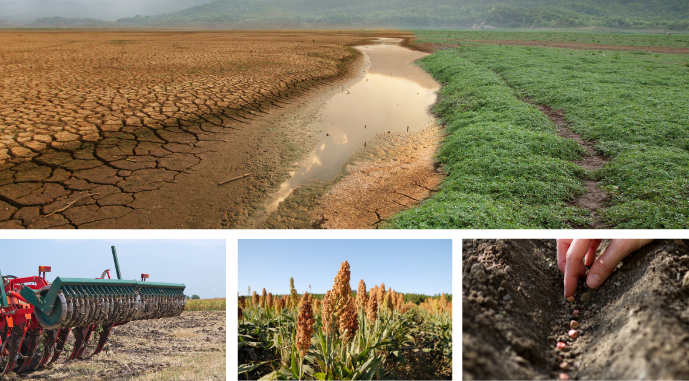 With the help of irrigation one can compensate for the shortage of moisture in the soil, and also in the short term reduce the temperature of the plants for a few hours. One can also reduce the temperature of the upper soil layer for a fairly short period of time, but at the same time the risk of the development of diseases on the plants increases. In strong heat irrigation will be inappropriate.
At the company LNZ Group there are more than a thousand hectares under irrigation, but at critically high temperatures irrigation is not carried out. These would be fairly significant ineffective costs, which would lead to losses.
Besides sprinkler irrigation, we also use drip irrigation on vegetable and berry crops, and sprinkler systems are applied on hybridisation plots and field crop sowings. Maize is the main crop in the crop rotation of our agroholding. In some years its share in the structure of sown areas reaches over 60%. When there were problems with export, we reduced the sowings to almost 50%, but after the improvement of the situation we are gradually increasing the share of maize in the structure of areas. Sunflower, on the other hand, we are reducing — mostly in favour of winter rapeseed.
A rise in temperature provokes an increase in the entomological load
A rise in temperature for all harmful objects to the greatest extent promotes the growth of the entomological load, which prompts an increase in the use of insecticides. In practice a situation has already formed that in almost every application of crop protection products it is necessary to add insecticides over the larger part of the territory of Ukraine, possibly except for the northern and north-western regions.
The western corn rootworm appeared in Ukraine quite a long time ago. It is a monophage, parasitises on maize, but it is already noticed on other yellow-flowering crops too, which flower in the second half of July – the first half of August, for example on sunflower or pumpkins.
On these crops it was not noticed that the western corn rootworm causes damage, but in the process of adaptation to the conditions of Ukraine the pest may try not only maize, on which it parasitises, but also other crops. Therefore we need to always be ready to control the number. It should be recalled that systemic active ingredients will provide protection over 2-3 weeks of all parts of the plant, in particular the newly formed ones too, from a broad spectrum and feeding method of pests. Whereas contact ones will neutralise the plants from the already present pests in the field, they have a fairly short protective period.
Adapting to weather changes should be done systematically
 The expert recommends paying attention to niche and more drought-resistant crops, especially for small farms, such as, for example, sorghum, millet, but recalls that these crops practically have no predictable sales market. Therefore he advises first finding a buyer, and then beginning to grow the niche crop.
An important factor in reducing the negative influence of external conditions, especially the shortage of moisture, will be the seeding rate. The yield of the vast majority of crops, except for rapeseed and soybean, for the most part depends on the number of plants in the population, and not on their individual productivity. So to establish the seeding rate it is necessary to determine the potential, which will mainly be limited by moisture resources. It is advisable at the end of the autumn-winter period: for the south — at the beginning of March, for the central and north-western regions — in the second half of March, when the moisture accumulation period ends, to carry out soil analysis and determine the reserves of productive moisture. Proceeding from the indicators of the moisture reserves, as a limiting factor, to orient oneself towards the seeding rate of spring crops, establish the level of nitrogen and mineral nutrition overall, the level of intensification of the technological chart.
Careful with fertilisers
Nitrogen binds moisture in the soil. 70 l of ammonia dissolve in 1 l of water, so an excessive rate, especially of nitrogen fertilisers, will bind the already small moisture reserves that are in the soil.
As for starter fertilisers, which are applied primarily to provide the plants with mobile forms of phosphorus under conditions of its inaccessibility from the soil, one needs to pay attention to the salt index of the fertiliser, it should be as low as possible. If too concentrated a solution is applied next to the seed, then in the future the osmotic potential of the embryonic roots decreases and, as a consequence, the plant's ability to assimilate moisture from the soil decreases.
Crop rotation — a strategic plan
Sunflower is the most drought-resistant crop, and one could sow many areas with it, but in 2-3 years face the fact that over the following 5-7 years it will be impossible to grow at all.
I want to give an example when at one of the farms a decision was made in 2022 to sow 100% of the areas with sunflower. In those fields where sunflower grew after sunflower, the percentage of affection by sclerotinia reached over 90% (stem and head), and where it grew every other year, and there were 40% of such areas, the level of affection was 50-70%. Thus they deepened the problem for years ahead.
In addition, sunflower takes mainly moisture and nutrients from the deeper soil horizons. According to the specialist, it is essential to carry out crop rotation, which will have positive consequences in various aspects. Crop rotation must be a strategic plan for at least 3 years, and preferably — for more.
The right hybrids form the right harvests
The growing technology of a crop from hybrid seed will affect the yield by approximately 50%, another 50% is the influence of the genetics, of the hybrid itself, how well it suits one or another condition, the technology of the specific field.
The harvest should be formed by the choice of hybrid and technology, these two factors have approximately equal influence. If we, for example, choose a high-quality hybrid that has the best potential, but the growing conditions do not correspond to its features, or we do not ensure the growing technology, then we will obtain the opposite result. In order to understand the hybrid composition of a farm, I would recommend carrying out studies. Testing hybrids on small plots, studying them over 1-2 years, after which carrying out the replacement of old ones with new ones.
It is important to ensure the features of the hybrid's genetics with the growing technology. To determine whether it has high cold resistance, whether it can be sown earlier, when there is still moisture, but at the same time a colder soil (7-8 °C, and not 10-12 °C), whether it can be sown in monoculture, what resistance it has to the influence of the present negative environmental factors, and so on.