2025
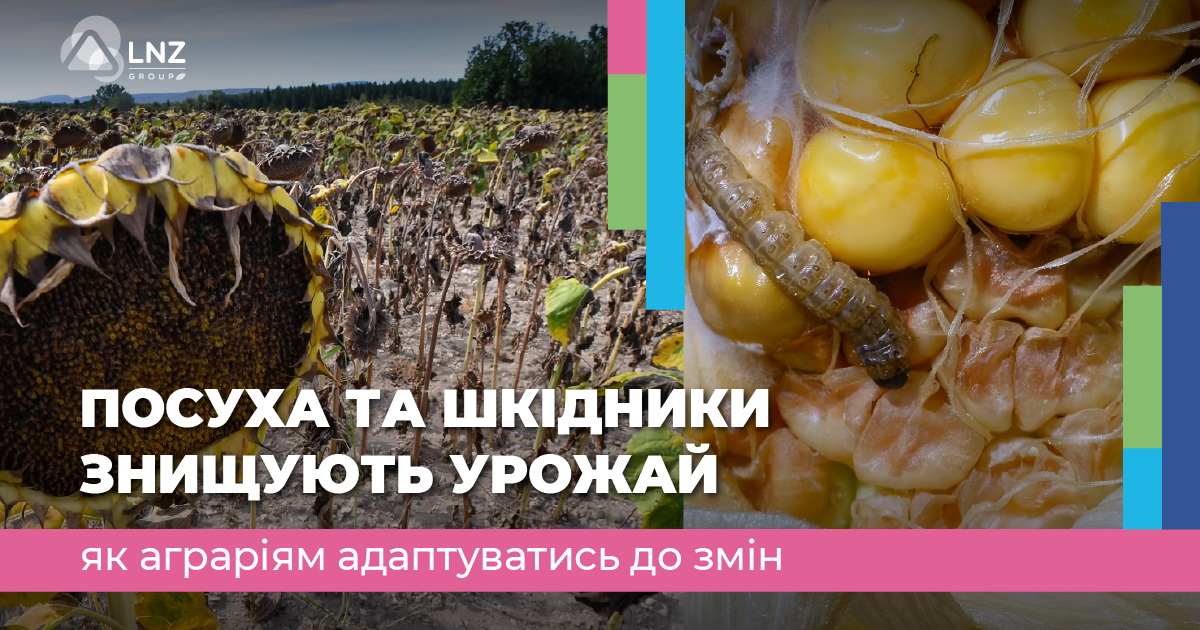 Farmers have for the most part learned to control weeds, worked out protection systems, have technological charts adapted to their conditions, so this issue is no longer so acute. But every year there is an observed increase in the entomological load and a growth in the harmfulness of pests.
The greatest load falls on the summer months with an extension of this period into the second half of May and September, so at this time the number of insecticide treatments increases.
AgroPortal.ua talked about the situation in the fields, grain quality, critical phases in crop growing and technologies that would help Ukrainian farmers adapt to climate change with the head of the LNZ Group Agro Department Oleksandr Khmeliuk.
Harvest quality: blackening of the grain does not mean infection with smut diseases
In many regions during the cereal harvest this year, blackening of the grain is recorded. Most such cases are in the forest-steppe and Polissia zones, where the harvest, as a rule, begins later, where the autumn dewy mornings come sooner, where there is more moisture.
Oleksandr Khmeliuk notes that such cases are indeed widespread in these regions, but they are of a more visual nature; in fact this does not indicate infection of the harvest with smut diseases.
This is a lesion mainly by spores of the fungus of the genus Alternaria, which is saprophytic and colonises wheat when the tissues are already dying off. During harvesting, when the grain passes together with the straw through the combine, these spores get onto the grains and lodge in the crease and on the brush. As a result we have blackened grain, which by standard is defined as smutted, although this is not a smut disease. And this is one of the ways of manipulating the price at elevators.
To avoid blackening of the grain, the specialist advises harvesting the wheat faster, while it is standing yellow, for which one can carry out desiccation. One needs to manage to harvest it before the first rains pass or before cool damp nights and mornings begin. When the period of active dew or fog has set in, nothing can be done anymore. Fungicide protection in this case also will not help.
Rapeseed: an increase in the entomological load
Rapeseed is a crop that requires constant attention and control of all harmful factors, starting from the moment of its sowing and until the combine has threshed it. This is a crop of constant risk, it regularly needs to be monitored, forecast and all factors — diseases, pests, weather — detected in time.
This year the specialist singles out several significant factors that had an influence on the crop:
- Temperature fluctuations after the resumption of vegetation in spring, frosts and freezes, when the temperature at night reached -5 °C. Part of the rapeseed froze out, and part stopped in development, branched little. But after gradual warming set in, the plants put out additional shoots.
- A very drawn-out flowering period and, accordingly, a very drawn-out ripening period of the rapeseed. The upper pods were fully ripe, while the lower ones had only just set. Depending on the region, the difference in ripening was 2-3 weeks. In this situation pods of different ripeness are on the plant at the same time, and the farmer needs to make a decision during harvesting: to lose the first or the last pods. Moreover, the grains in such a crop are of very different quality, which leads to a decrease in quality indicators overall.
"This did not significantly affect the yield gain, but, besides quantity, quality is also important. Unripe grain will have a high content of free fatty acids (a high acid value), that is, it will no longer be suitable for use for food purposes, but only for technical ones. The price of such a harvest will be corresponding," explains Oleksandr Khmeliuk.
The current season also turned out to be difficult in terms of pests. Although in the LNZ Group Agro Department, relying on the opinion of climatologist experts, they forecast changes associated with an increase in the entomological load. The company notes that if in the south five years ago insecticides were traditionally added during every rapeseed treatment, in the west they were used more situationally. But now, after the sharp increase in the entomological load, the use of insecticides on rapeseed at every application and unscheduled — is already a necessity.
Sunflower and maize: an emphasis on the control of lepidopterans
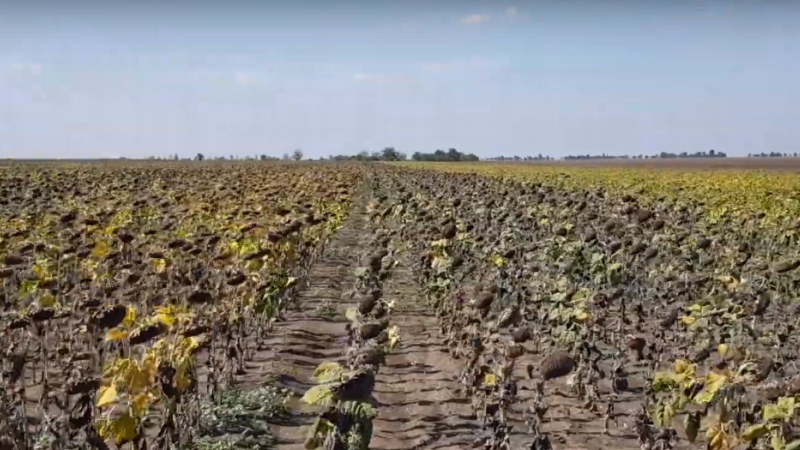 The year turned out to be difficult for sunflower and maize too. These crops simply burned up in the Mykolaiv region, partly in the Dnipropetrovsk and Kirovohrad regions.
"In these regions at best farmers will harvest 1.5-2 t/ha of maize, and many will disc it under, or less than 1 t/ha of sunflower. The yield in other regions will depend on the further situation with temperature and precipitation. Overall for maize one element of productivity remains — to reach the thousand-grain weight, and for this there needs to be enough moisture for the filling," relates Oleksandr Khmeliuk, who over the last two weeks has seen the full picture of the state in which the crops in the south of the country are now.
In the LNZ Group Agro Department they emphasise that in those regions where sunflower and maize still remain, it is important to control lepidopteran pests and not miss the stage of the larva emerging.
"While there is the stage of the 1st-2nd instar larva, which is located and feeds on the surface of the leaves, it can still be controlled with insecticides. The larva that has gnawed through and climbed inside the stem or into the cob can no longer be reached by anything. In that case it only remains to hope that there will not be a strong wind that will knock down the stems. And one must immediately take into account the risks of a decrease in yield and quality," explains Oleksandr Khmeliuk.
An effective means in the fight against lepidopteran larvae is the systemic insecticide of the DEFENDA brand Kairos, SC flubendiamide, 480 g/l. In order to broaden the spectrum of control across the phases of the pest's development, to obtain a direct ovicidal action, the insecticide Prosens should be added to Kairos.
Soybean: if there is moisture — there will be a harvest
To obtain a good soybean harvest, a necessary component is the presence of moisture in July and August. The most critical period of moisture use in soybean is flowering and filling.
Soybean changes its structure literally in 2-3 days. Under unfavourable conditions it can drop, abort a generative organ at any phase of its development, starting from the bud that is to become a flower, the flower, the grain, the bean. Therefore the yield cannot be counted by the number of set pods. At the end of July, when the crop has finished flowering and set beans, it is very early to count the profit. For if there is no moisture in August, the soybean will drop beans every few days. In not too dry regions in the best years 3 t/ha were harvested. In the west of the country the soybean yield reaches up to 4 t/ha and more, and this is thanks to the fact that in this region there is moisture. In the southern ones — 1-2 t/ha, or even less. A problem in soybean crops remains the mite. Last year a significant colonisation by it was observed, and after overwintering it appears again on the crops. The spread of pests is promoted by the rise in temperature and global climate change, mainly — the mild winter.
The difficulty of the fight lies in the fact that most pesticides control the mobile stages of development, but do not control the egg stage. So it is important to diagnose the mite in time at the edges of the field near the roadside, the shelterbelts, from where it begins to spread deep into the crops. After timely detection of the pest at the edge of the field, and at a distance of 20-30 m, when it is not yet there, only edge treatment of the fields may be sufficient.
The specialist advises combining two types of products in a tank mix: a pesticide that will control the mobile stages, and a second — an active ingredient with an ovicidal action, which will control the egg stage.
If one uses only a pesticide that controls the mobile stages of the pest, then depending on the temperature, in 5-7-10 days, it will appear again. And the crops will need to be treated again, and there can be 2-3 such treatments. In order to diagnose the pest in time, one needs to monitor the temperature. The mite likes dry and hot weather. If we see a forecast of a rise in temperature, one needs to take a magnifying glass and inspect the edges of the fields.
Source: Agroportal