2025
Early fruiting, technological efficiency, the presence of a variety offer, and the main thing – high taste qualities and the favour of buyers, ensure success in growing this crop.
In 2023, 68 strawberry varieties were entered into the State Register of Plant Varieties Suitable for Distribution in Ukraine. The applicant country for 20 of them is Ukrainian institutions, 18 – Italy, 12 – the Netherlands, 9 – the USA, 7 – Great Britain and 2 Germany. The vast majority of the strawberry varieties of foreign origin presented in the register are suitable for growing both in open and in protected ground. At the same time the Ukrainian varieties are either not tested for such a growing method, or are suitable only for growing in open ground.
When selecting a variety set for growing strawberry, one should remember that the best one, even taking into account the world collection, does not exist. One should pay attention to 3-5 varieties that suit you by resistance to unfavourable environmental factors and will ensure the necessary period of fruit sale.
When establishing a plantation, besides the variety, the choice of plot, soil preparation and the construction of the plantation are of important significance. The best soils for growing strawberry are medium and light aerated ones with a slight slope, since the root system of strawberry does not withstand oversaturation of the upper layer with water. Strawberry should preferably be planted in plots protected from strong winds, where better moistening conditions are created during the growing season. Plants in a sheltered spot are less damaged by dry winds, and the flowers are better visited by insects.
If you did not manage to avoid unfavourable weather conditions, the foliar application of the anti-stress fertiliser DEFENDA AMINO at a rate of 0.5-1.0 l/ha activates the physiological-metabolic and reproductive processes, will help the plants come out of the critical state.
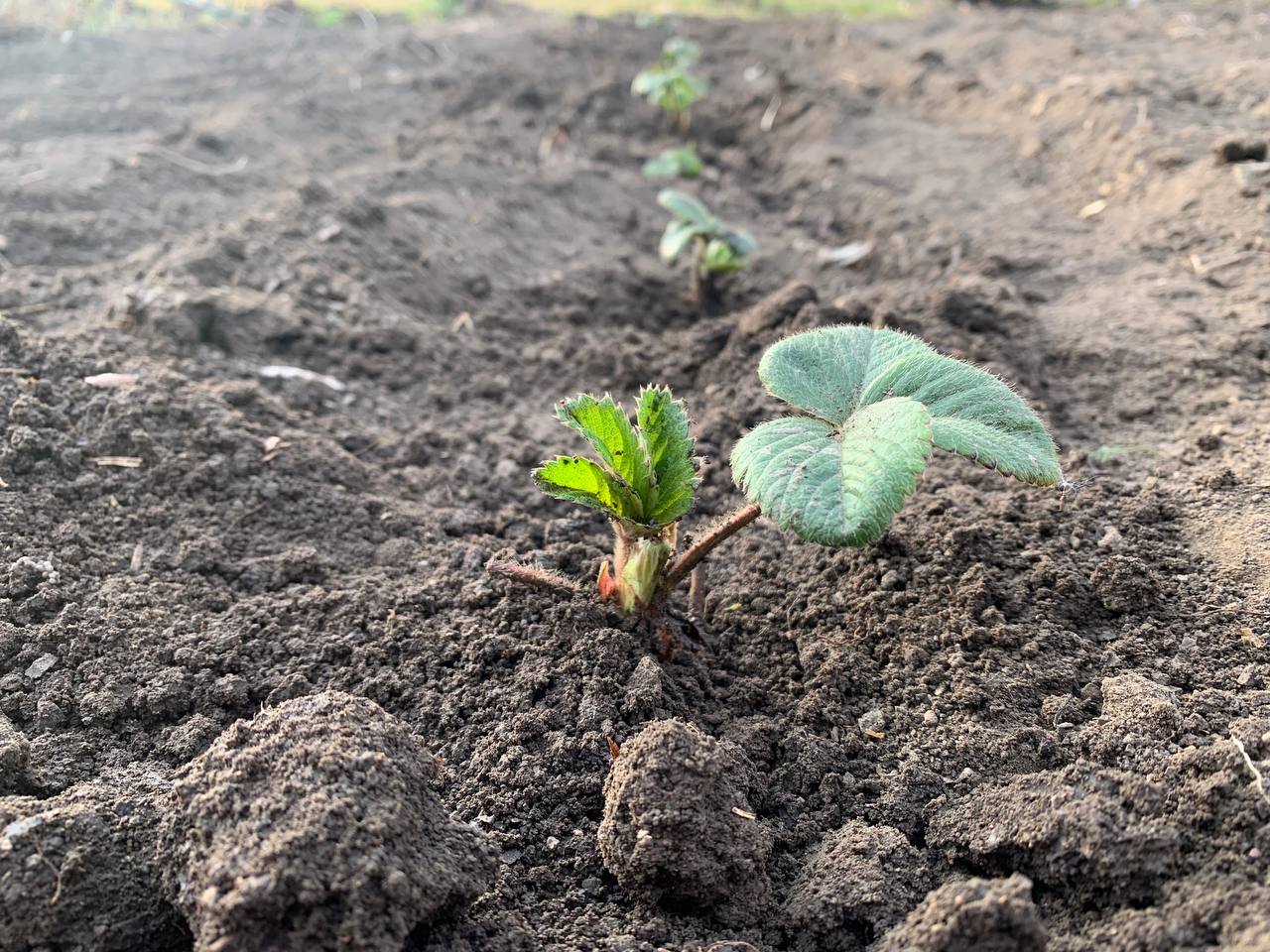 The best time for planting strawberry seedlings with an open root system (frigo) is spring, the period of the beginning of field work, when there is still enough moisture, and the soil has ripened and warmed up to 10-15 degrees. For planting it is advisable to use healthy seedlings, which will increase the productivity of the berry plantation by 7-25%.
The best for establishing a berry plantation are plants that have a root collar thickness of 10-15 mm. The number of plants per hectare can be within 28-40 thousand with the usual and 50-60 thousand plants per hectare with the dense planting scheme.
To reduce stress and stimulate the growth of the roots and vegetative mass of the plants, before planting, the root system of the strawberry planting material should preferably be treated with a 0.1% solution of DEFENDA ASKO HUMATE – a functional fertiliser of directed action.
At the beginning of flowering, the flower stalks are removed from the plants planted with frigo seedlings, this promotes the laying-down of fruit buds for the following year. During the first year of the growing season, fungicide and insecticide protection is carried out on the berry plantation, herbicide fighting of weeds, which in combination with inter-row treatments makes it possible to remove the interspecific competition for nutrition and moisture, create conditions for laying down the harvest for the following year.
To ensure a favourable water-air regime in the ground layer and improve the quality of the strawberry berries, mulching of the plantations with straw is used. The straw on the berry plantation is spread in the second year from planting, before the lowering of the flower stalks.
In berry plantations designed for harvesting a marketable harvest in the first year of the growing season, first beds are formed, irrigation hoses are laid, film is spread, which is fixed with soil on both sides of the bed, and only after this the strawberry seedlings are planted into the made holes. During the year the care of intensive strawberry plantations consists of halting the intensive growth of the plants after harvesting, treatment with protection products against diseases and pests.
To stretch out the duration of fruiting for the purpose of obtaining a late harvest of strawberries, neutral-day varieties are planted, which under favourable temperature conditions are able to bear until late autumn. Neutral-day varieties are especially demanding of nutrition conditions. To ensure constant fruiting, increased rates of potassium, nitrogen and boron are needed.
An easily accessible source of boron for plants before flowering is the mono-element fertiliser with a special formulation DEFENDA BORON, which at a rate of 0.5-1 l/ha by means of foliar feeding is able to compensate for the deficiency of the microelement on all agricultural crops.
To ensure the normal development of the plants and the obtaining of a harvest of high quality, the optimal is regular feeding of the plantations with universal fertilisers using drip irrigation.
DEFENDA MACRO – a highly effective, balanced fertiliser, developed for the quick compensation of macro- and microelements by means of fertigation or foliar feeding. It promotes the quick building-up of the root system, increases the size and intensity of the colouring of the berries.
In the summer months, to avoid overheating of the soil under the film, sprinkler irrigation of the plantations, spreading of straw or white agrofibre is carried out.
The labour costs when growing strawberry on film decrease by 25-30%, by approximately the same amount the costs of establishing the berry plantation increase and the profitability of fruit production increases.
Source: Kurkul.com