2025
 The 2025 season became a real test for Ukrainian farmers — from a cold spring to an unstable autumn. Such conditions forced producers to reconsider their approaches to hybrid selection, protection technologies and the sowing structure. How to adapt to the new climatic realities? What criteria should be taken into account when choosing corn and sunflower seed material? And what trends will determine the 2026 season?
We asked the specialists of Limagrain Ukraine about this, and they shared their own observations, research results and practical recommendations on choosing hybrids for various technologies and regions.
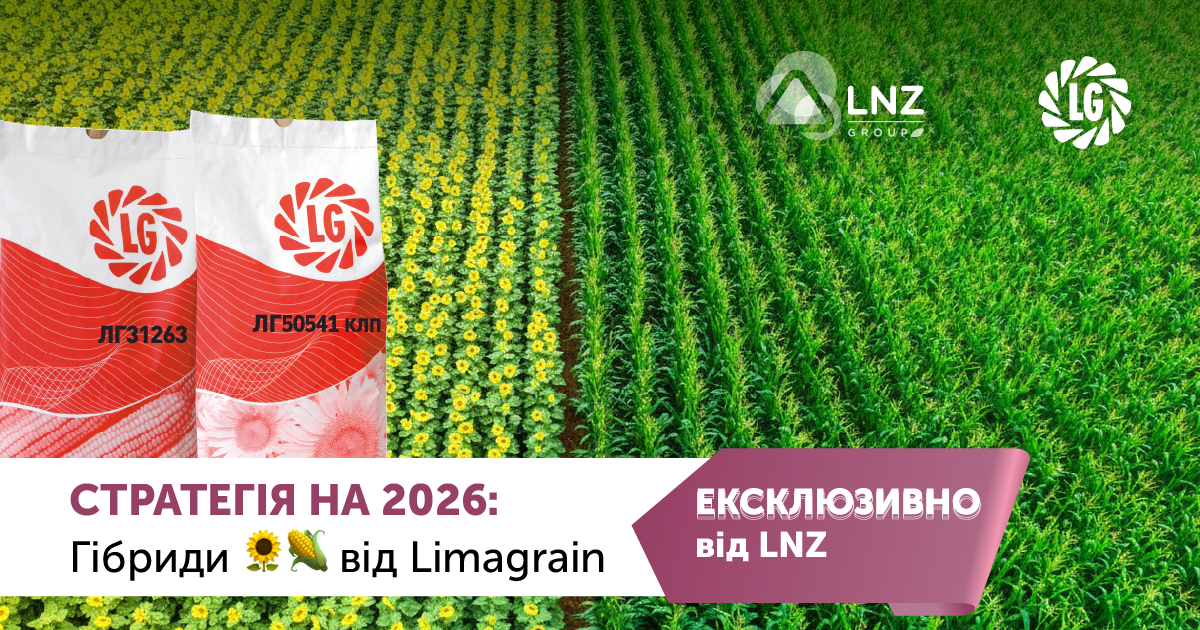
First of all, they noted that a new stage of cooperation between the two companies has begun, within which LNZ Group receives exclusive rights to the supply of the corn hybrids LG 31263 (FAO 270) and LG 31332 (FAO 310), as well as the mid-early sunflower hybrid LG 50541 CLP from Limagrain. From now on producers will be able to purchase these hybrids exclusively through LNZ Group representatives.
 In addition to commercial distribution, the company will also have exclusive rights to the field and factory production of the hybrids LG 31263 (FAO 270), LG 31332 (FAO 310) and LG 50541 CLP from LG Seeds. Such a format of cooperation expands the possibilities of the partnership, creates a foundation for new joint projects and contributes to deepening cooperation between the companies with the prospect of forming even more attractive offers for producers.
Given the weather conditions of the 2025 season, what criteria should farmers be guided by when choosing corn and sunflower hybrids for the next season?
In 2025 we felt changes both in the spring period — for the sowing campaign, and in the autumn period — for the harvesting campaign. Spring turned out quite cold, and this complicated both corn development and the protection systems. We could observe suppression of the crops and stress. Protection systems also worked differently, because it was difficult to comply with the product application regulations, which in turn caused additional stress on corn. On the other hand, one could observe that early-group hybrids, for example LG 31263, developed better and better tolerated cold and herbicide stress thanks to high tolerance, which accordingly was a plus in faster ripening and moisture shedding. As of October, these hybrids already had, depending on the zone, a grain moisture of 22-26%, whereas others — 26-35%. Therefore, in our opinion, we definitely recommend reconsidering the corn maturity groups towards earlier hybrids.
Drought tolerance as an important characteristic of corn and sunflower in the new climatic conditions: why is it important, how does it manifest, how does it help reduce weather risks?
Drought tolerance is a rather interesting term. It is a mistake to think that corn under harsh dry conditions will show a result of 7-10 t/ha. Therefore we need to approach this indicator comprehensively. Corn's tolerance to drought also depends on the technology. In particular, optimal (minimal) tillage aimed at preserving moisture in the soil, the use of cover crops and, of course, crop rotation. Yes, indeed, Limagrain approaches corn hybrid trials quite comprehensively and has a patented Hydraneo technology, according to which hybrids receive a drought-tolerance index, and the higher it is — the better the hybrid performs under dry conditions, and the main factor is precisely drought tolerance. And this factor is used in all research, including in the silage direction. For example, according to the results of research under the Hydraneo programme, the hybrid LG 31271 received a high drought-tolerance index, so it was awarded the Hydraneo label. Speaking of grain corn, among the new items LG Seeds has powerful hybrids that show an excellent result under optimal conditions and at the same time — under dry ones.
Plasticity of hybrids: how pronounced it is, how it manifests (range of sowing dates, seeding rates, the possibility to sow in different climatic zones, etc.)
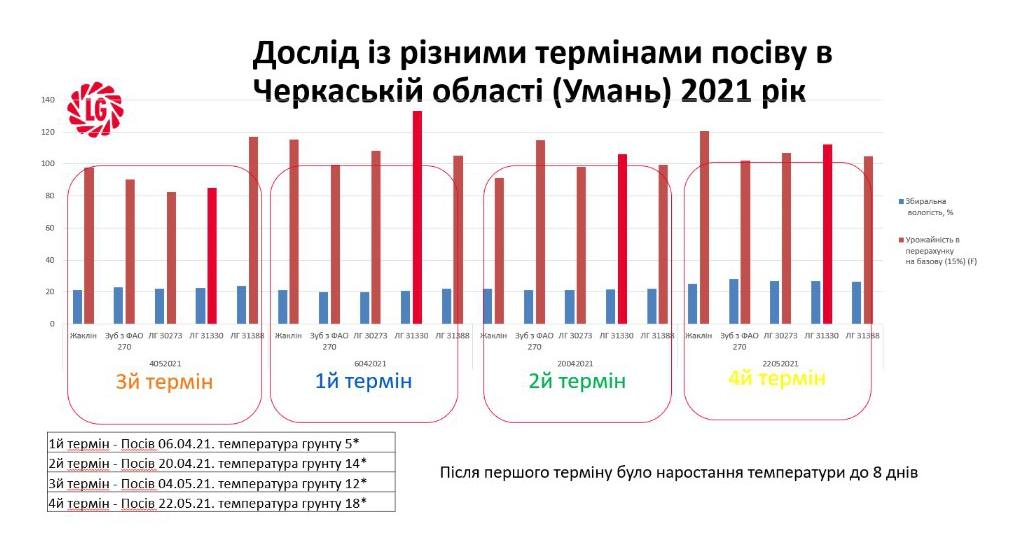
Plasticity is a rather interesting word for describing a hybrid's performance. On the one hand, it is, so to speak, a hybrid for all needs, and on the other — many agronomists understand by such a hybrid characteristic that under harsh conditions the hybrid will perform best, and then compare other hybrids under good conditions. Therefore the plasticity of a hybrid provides the possibility of a larger "window" of its use, but any unfavourable conditions still affect the result, and at the same time other hybrids perform significantly worse under such (unfavourable) conditions.
For example, in 2021 we conducted research in the Cherkasy region (Mankivka village) of different sowing dates — from early (06.04.2021) to late (22.05.2021). The hybrid LG 31330 showed a good result on all four sowing-date variants. The hybrid LG 31332 also shows excellent results on different sowing dates.
If we take different growing regions, in all regions of Polissia and the Forest-Steppe the hybrid LG 31305 performed well. In particular, in 2025:
- in the Chernihiv region, Bakhmach district, 12.6 t/ha was obtained with a moisture of 28%,
- Zhytomyr region, Popilnia district — 10.6 t/ha with a moisture of 20.6%, Liubar district — 13.3 t/ha with a moisture of 22.3%,
- Cherkasy region, Uman district — 8.6 t/ha with a moisture of 16%,
- Poltava region, Pyriatyn district — 14 t/ha with a moisture of 22%.
 But at the same time this hybrid will not be the best choice for excessively compacted soil. For such conditions a better option will be LG 31272. It has proven itself excellently on various growing technologies and in various soil and climatic conditions. This hybrid's genetics have excellent drought tolerance embedded thanks to better pollination and grain filling due to a strong root system.
How should sunflower and corn hybrids be chosen for "economical" technologies: resource-saving tillage, reduction of fertiliser application rates, etc.?
We must clearly understand that to obtain a normal result it is necessary to invest money in fertilisers and protection, on the other hand, we need to find a balance in this. And here it is worth paying attention to the hybrid LG 31332. The maturity group FAO 310 is the most optimal for the market and conditions of Ukraine and will suit most regions. The hybrid has proven itself excellently on different sowing dates. The best dates, of course, are the optimal ones, and if there are large sowing areas, then the hybrids can be used on early - optimally early dates, and very good results were obtained with sufficient moistening — over 10 t/ha. For example, in 2021 in trials with replications across seven locations in the Polissia and Forest-Steppe zone we obtained an average result of 10 t/ha with an average moisture of 23.7%
Forecasts for the 2026 season and recommendations on hybrid selection: what harmful factors are expected, accordingly which seed treatments and hybrid parameters are needed; which corn FAO to choose for different regions, taking into account the weather conditions?
Forecasts are always a thankless task, but let us try. First of all we recommend reconsidering the hybrid selection and giving preference to hybrids with an FAO below 300. And to pay attention to hybrids that tolerate low temperatures well. In 2025 we could see that, for example, LG 31272 had better development of both the vegetative mass and the root system, and the grain moisture was lower by 5%, and in some cases more. In addition, the hybrid LG 31332 performs quite well despite the fact that it is in the maturity group at the beginning of FAO over 300. Also, 2025 showed that early-group hybrids ripened faster and had a significantly lower grain moisture, which was economically more advantageous when drying the grain. One should also choose seed with a full complex of treatment, which is available at the LNZ Group plant. In 2025 we could observe better development of the plants and the root system, and could also visually verify better stress tolerance by the corn.
Advantages of processing sunflower and corn hybrid seed at LNZ Group's own plant.
The Lebedyn seed plant is equipped with high-class equipment from global producers and works according to standards that meet the highest requirements of the seed industry.
 The technological process here consists of nine stages — from receiving the raw seed to shipping the finished product. At each stage seed-treatment control is carried out: the seed is coated with a protective substance that ensures protection against pests. For this, the batch-action treater CT200 (PETKUS) is used.
After applying the treatment, the seed is additionally dried to prevent sticking and ensure its flowability. Then the finished, packaged product goes to a certified warehouse, where it is stored until the moment of shipment to the client.
One of the important advantages of the plant is the possibility of high-precision calibration. The facilities make it possible to sort the seed into four fractions: by size (large and medium) and by shape (round and flat). For comparison: most European plants work with only two or three fractions.
Such sorting is especially important for Ukrainian farmers, who mostly use mechanical seeders — uncalibrated or unevenly calibrated seed often clogs the coulters, complicates sowing and impairs sowing uniformity.