2025
Soybean is one of the crops most sensitive to weed competition, especially at the initial stages of development. Insufficient protection can lead not only to yield losses, but also to serious problems during harvesting.
Serhii Ivaniuk, agri-technology development manager in the Central region of the company LNZ Group, related the features of the application of post-emergence herbicides in soybean crops and the conditions under which they become the most effective.
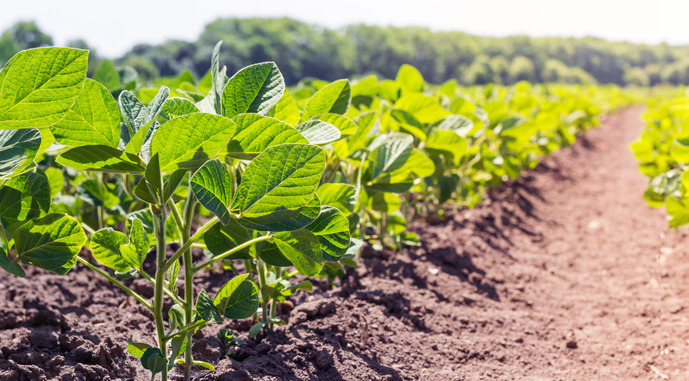 The choice between base and post-emergence herbicides
The standard soybean protection scheme includes treating the crops with a base (soil) and a post-emergence herbicide. However, sometimes farmers neglect one or the other, thus seeking to make the technology cheaper.
To the question of the possibility of building a protection system exclusively on post-emergence herbicides, Serhii Ivaniuk gives a considered answer, that in practice anything is possible. True, such experiments must be justified.
"The decision must be made individually for each field taking into account the specific conditions. Post-emergence herbicides have the advantage of being able to correct the strategy depending on the real situation with the weeds, whereas soil ones work preventively," notes the expert.
But in the absence of soil moisture at the time of soybean sowing, post-emergence products should definitely be considered.
How to build a soybean protection scheme?
To build a soybean protection scheme, first of all the agronomic conditions of the field should be analysed:
Soil type. For example, on sandy soils, because of the quick leaching of soil products, it is better to work with post-emergence herbicides. For heavy soils, soil herbicides with a long action are more effective.
The spectrum of weeds in the field (annual or perennial, grass or dicotyledonous).
The soil pH level. It affects the activity of many products.
The preceding crops in the rotation. For example, if the preceding crop was cereals, then dicotyledonous weeds will dominate, if maize or sunflower — volunteers are possible, and so on.
The tillage system. With traditional tillage one can use lower application rates of soil products, whereas with no-till — on the contrary.
Soil moisture at the time of treatment. If there is enough moisture, the expert recommends the proven combinations of soil herbicides Sora-Net+Perun (2-2.2 + 1.8-2.0 l/ha), Matar (0.350-0.6 l/ha) or Sora-Net+Clutter (2-2.2 + 0.200 l/ha)
These schemes have performed well in production conditions.
Dicotyledonous weeds and herbicides against them
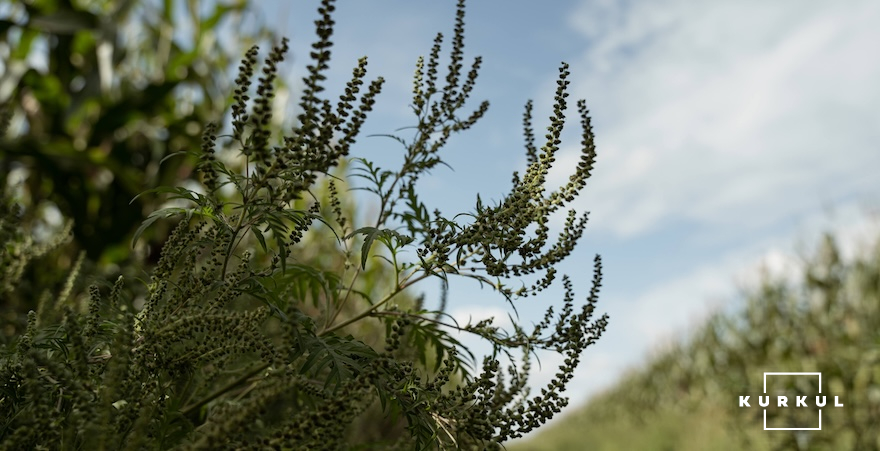 Dicotyledonous weeds pose a particular problem for soybean, since the crop itself belongs to this group, which complicates the selectivity of herbicides. In soybean fields both annual dicotyledons — common knotweed, scentless mayweed, common ragweed, and perennials — sow thistle or dandelion are found.
For post-emergence protection against dicotyledonous weeds Serhii Ivaniuk singles out the combination Banten + Clutter (2.2-2.5 + 0.150 l/ha). The products work more effectively when the adjuvants Macho and Super Macho are used.
"An effective combination will be of two products that will have the widest possible spectrum of control, and the synergy of the two products will only increase their effectiveness," he adds.
Dicotyledonous weeds are most vulnerable in the 2-4 true leaves phase, so it is important not to miss the optimal treatment time.
The most dangerous enemies of soybean — grass weeds
Grass weeds pose a particular threat to soybean because of their quick initial growth and their ability to compete effectively for resources at the early stages of crop development.
"Soybean has low competitiveness against weeds, especially at the initial stage of the growing period. Among the weeds, perennial and annual grass weeds represent a greater threat to the crop," emphasises Serhii Ivaniuk.
 The most dangerous period is the first 3-4 weeks after soybean emergence, when the grasses grow significantly faster than the crop and can completely suppress it. Yield losses can reach 40-70% with severe weed infestation. The most problems are created by annual grasses: grey and green foxtail, barnyard grass. "An effective solution is the use of the herbicide Starlent (propisochlor, 360 g/l + terbuthylazine, 190 g/l) with an application rate of 3.8-4.5 l/ha," says the specialist.
For perennial grasses, such as couch grass, among the active ingredients clethodim and quizalofop-P-ethyl will be effective, which are components of Blade and Haruma. A milder graminicide for soybean will be the product Blade (clethodim).
Problematic broadleaves: ragweed, goosefoot and volunteers
Among the broadleaf weeds, one most often has to fight with white goosefoot, ragweed and sunflower volunteers. These species are difficult to control because of their biological feature and their ability to grow quickly.
"To achieve maximum effectiveness it is important to act in time. The optimal moment for applying the herbicide Banten. It should be applied when the bulk of the weeds are at the early stages of development in direct sunlight," emphasises Serhii Ivaniuk.
This rule is relevant for all post-emergence products — the younger the weeds, the easier they are to control. The most important period is the 2-4 true leaves phase of the weeds, when they are most sensitive to herbicides. A delay with the treatment sharply reduces the effectiveness of the products.
Timing of the protection
The period of application of post-emergence herbicides is critically important. Serhii Ivaniuk defines the optimal window: from the BBCH 13 phase to BBCH 30-49 (V1-V3), that is in the period from the 1st to the 3rd true leaf of the crop.
"So in this period one needs to carry out the treatment to protect against weeds," emphasises the expert.
As for the development phase of the weeds, here the rule is simple: overgrown weeds react significantly worse to the action of herbicides, especially systemic products. For perennial weeds somewhat different rules apply. The application is carried out from the 1st to the 4th trifoliate leaf of the soybean, although the expert notes that there are some force majeure circumstances, but they are considered as an exception in accordance with the soybean phase at a critical weed infestation.
The weather as a determining factor
Weather conditions can radically affect the effectiveness of post-emergence herbicides. Serhii Ivaniuk clearly outlines the optimal parameters — a temperature regime from 10 to 25 ℃ without precipitation. For bentazon-based products, such as Banten, direct sunlight is additionally needed. Low temperatures are especially harmful to the effectiveness of the treatments. "The effectiveness of post-emergence herbicides decreases under unfavourable weather conditions. The greatest influence is from low air temperature (below +10 °C) and the absence of moisture in the upper soil layer," explains the expert.
An interesting pattern is observed with moisture. On the one hand, the complete absence of moisture makes the herbicide inactive, on the other — excess moisture can wash the product into the deeper soil layers, where it becomes ineffective. This especially concerns soil herbicides.
"For the normal action of the product, moderate moisture is needed — it is exactly this that activates the active ingredient," sums up Serhii Ivaniuk.
Serhii Ivaniuk's experience shows that the best results are given by a comprehensive approach to planning the herbicide protection. It is important to take into account not only the weather conditions and development phases, but also the potential weed infestation of the specific field, its history, the preceding crops and many other factors. The expert emphasises the importance of prevention: insufficient protection of soybean from weeds at the early stages can lead not only to a decrease in yield, but also to serious problems with harvesting and processing the crop. This means additional costs for desiccation and a negative impact on the quality and marketable characteristics of the seed.