2020
 One of the important factors in obtaining a high and, above all, stable corn yield is the right choice of hybrids. This determines the hybrid's ability not only to build high potential under certain conditions, but also to realize it thanks to its ability to withstand various stress factors and adverse weather conditions of the region or year. Therefore, when choosing a hybrid, it is necessary to consider first of all the growing zone.
The growing zone should include climatic, weather and soil characteristics. In southern regions on fertile chernozem soils, it is worth sowing hybrids with good and high drought and heat tolerance, while in the zone of sufficient moisture (north and west of Ukraine) – those capable of building high potential, but necessarily taking into account the insufficient amount of solar radiation (FAO limitations, maturity groups) and soil type. In addition, they must be resistant to cold stress and diseases.
In addition to zonal characteristics, it is advisable to take into account some important technological and resource-economic features of farms, in particular:
- the preceding crop, since not all hybrids can fully reveal their potential, especially in monoculture. Problems may arise with significant saturation of the soil with organic residues and partly disease spores, which will negatively affect the productivity of certain hybrids. Some hybrids have a weak and thin stalk, which in monoculture can lead to lodging due to stalk fusarium or intensive damage by the European corn borer, etc. After such a difficult preceding crop as sunflower, not all corn hybrids are able to realize their potential due to a lack of nutrition and a significant moisture deficit in these fields;
- resource provision. For intensive technologies, hybrids should be chosen that are capable of forming and realizing high potential and respond well to increased nutrition;
- soil tillage, which plays an important role in the formation and development of the plant root system, since not all hybrids are able to form a powerful root system when sown after shallow tillage or under no-till technologies;
- sowing time. It is very important to take into account if this process takes you a long time, so that sowing is carried out early. Cold-tolerant hybrids will be needed here, but at the same time it is advisable to sow into warmed soil;
- harvest time and duration – a decisive factor for large farms where the harvest period can be prolonged. Here it is important to grow hybrids that can stand in the field without loss of yield quantity and quality;
- dry-down is of great importance for those who do not have dryers or need hybrids with fast dry-down to start harvesting earlier.
And since it is difficult to obtain universal hybrids through conventional breeding, all leading seed companies have hybrids with certain qualitative characteristics in their portfolios that will fully meet your needs, taking into account soil-climatic, weather, resource and technological conditions.
However, in order to figure out which hybrids to choose, it is better to form the necessary hybrid profiles according to the desired characteristics and select hybrids on their basis.
And to demonstrate how this can be done, we propose to consider some hybrid profiles for individual zones. Such an approach will ensure a more accurate selection of hybrids for your conditions and needs, which will help obtain consistently high yields from year to year, and therefore profit.
For example, for the zone of sufficient moisture (Ivano-Frankivsk, Zhytomyr, Chernihiv, Kyiv regions) on light and sandy soils, when forming hybrid profiles, the mandatory factors, in addition to maturity (FAO), are:
- cold tolerance;
- powerful root system development;
- high yield potential;
- intensive growth at the initial stages;
- good disease resistance;
- fast dry-down;
- suitability for standing in the field.
If we evaluate hybrids of North American and Canadian breeding (NAPG) according to these characteristics, only a certain number of hybrids meet the given parameters. For example, let us consider the selection of hybrids for this profile (Table 1).
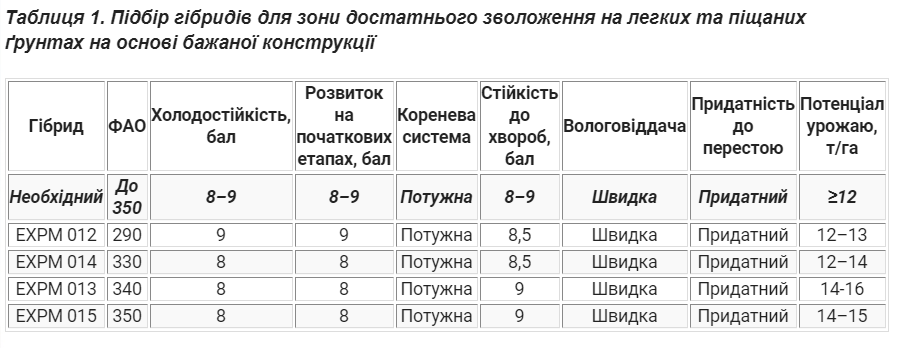
Thus, out of a small number of registered hybrids (8), we are left with 4 that meet the desired qualitative characteristics in this zone on soils light and sandy in texture.
For the zone of sufficient moisture in Ternopil, Vinnytsia, Kyiv, Chernihiv, Sumy and Poltava regions on medium-textured soils, when forming the basic profile of the required hybrid type, it is advisable to take into account the following parameters:
- strong stalk;
- high disease resistance;
- fast dry-down;
- good stress tolerance;
- high yield potential.
For this region on heavy-textured soils, it is advisable to add to the hybrid profile cold tolerance parameters, since this soil warms up slowly, and powerful root system development for its successful formation in heavy, crusting soil.
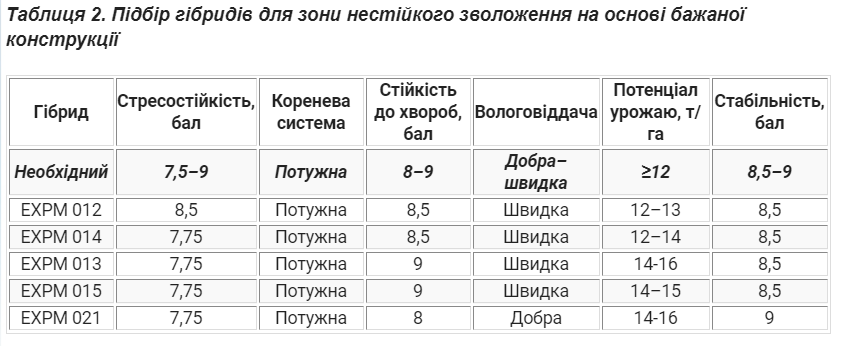
For the zone of unstable moisture, it is better to use the following profile of the desired hybrid:
- powerful root system;
- good and high stress tolerance (cold, heat, drought tolerance);
- good disease resistance;
- good or fast dry-down;
- high potential;
- high stability (Table 2).
As for southern regions with insufficient moisture, a fairly large amount of solar radiation and high temperatures, the main indicators for corn hybrids are:
- heat and drought tolerance;
- powerful root system development;
- rapid development at early stages;
- stability from year to year.
So, if we evaluate hybrids according to this profile, we are left with a certain range of hybrids. We immediately sort out those that are not suitable for the needs of the zone. Is such information enough to choose hybrids? In most cases it may not be enough, since you also need to overlay your own agrotechnological features and resource capabilities. Therefore, it is mandatory to add to the profile of the hybrids you need, in addition to zonal (climatic, weather and soil) factors, the agrotechnological features of the farm, in particular, as we have already mentioned: the direction of the fertilization system technology (intensive, extensive, adaptive); the possibility of sowing corn in monoculture or after poor preceding crops; the start of sowing (at what soil temperature you start); the duration of the harvest period, which determines the need for hybrids suitable for standing in the field; the type of soil tillage (ploughing, deep loosening, shallow, no-till technology), etc.
We, in turn, as your partner, are ready not only to provide high-quality seeds of these brands, but also to help with the appropriate selection of hybrids.
Therefore, for the correct and successful choice of corn hybrids, we recommend drawing up desired hybrid profiles according to the soil and climatic conditions of the region, your own technological and resource provision and the agrotechnological features of growing the crop, which will help reduce the risk of yield shortfalls from year to year.
Agronomy Department of LNZ Group
Source: AgroPortal