2025
Soybean production in Ukraine is characterised by dynamic growth of sown areas and gross harvests depending on the demand on the market. Despite the increase in areas under this crop, the yield and seed quality indicators could be better.
 One of the causes of the shortfall in the soybean harvest is its damage by disease pathogens — grain losses can amount to 30-40%. And this moment is tangible with the saturation of the crop rotation with soybean and high-margin crops (sunflower, rapeseed) with common diseases.
Soybean is affected by over 50 diseases, of which over 30 are fungal, 12 bacterial, 6 viral and others. Disease pathogens can affect this crop at all stages of plant growth and development — from seed germination to full ripeness.
To limit the harmfulness of soybean diseases and ensure the obtaining of a quality harvest, one needs to constantly carry out phytosanitary monitoring of the seed material and the plants during the growing season in order to prevent the most dangerous pathogens.
According to data from the Institute of Plant Protection of the NAASU, over recent years a number of phytopathological analyses of soybean seed from various agricultural firms and enterprises have been carried out. In the examined samples the total amount of affected seed amounted to from 4 to 15%. Among the disease pathogens the most numerous group was represented by fungi. The fungal flora ranged within from 50 to 100% relative to the total amount. Seed affected by bacteria amounted to 12-28%, and by mixed infection, that is bacteria and fungi simultaneously — 14-35%.
According to DSTU 2240-93, the affection of soybean seed is regulated by such diseases as bacteriosis (10%) and fusarium (5%).
In the presence of pathogens on the seed, its laboratory germination in almost all samples was high and amounted on average to 84-93%. The seed that did not germinate was infected mainly by mixed infection and the development of the disease during seed formation (affection of the cotyledon and seed coat).
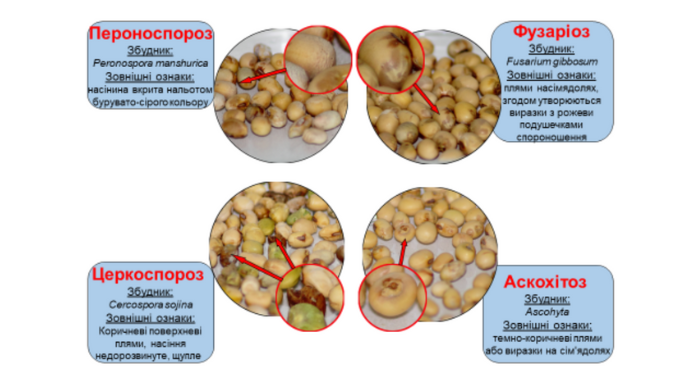 The presence of the pathogens of fungal diseases, which are located in the micro- and macro-cracks of the seed coat, are well controlled by seed treatments from DEFENDA: Ares (metalaxyl-M) 0.030-0.040 l/t, a systemic fungicide against fungal diseases + Fuksia (fludioxonil) 1.0 l/t, a contact fungicide against fungal diseases.
With these products one can combine a soybean inoculant (strain Bradyrhizobium japonicum). At the same time no decrease in the number and mass of the nodule bacteria is noted.
In recent years a significant amount of pests on soybean is noted, so it will be appropriate during the pre-sowing preparation of the seed to apply an insecticide, and for better starting growth also microelements. There is a good offer from DEFENDA: Ares (metalaxyl-M) 0.040 l/t + Fuksia (fludioxonil) 1.0 l/t + Metaksa (thiamethoxam) 1.3-1.7 l/t + DEFENDA seed 1.5-2.5 l/t + liquid soybean inoculant.
In the presence of bacterial infection, products with the a.i. Thiram should be considered, and in this case the inoculant with simultaneous seed treatment should be excluded (the volume of the working solution must not exceed 8 l/t).
Sowing soybean
Heat requirements (sowing dates)
The optimal temperature for seed germination sets in when the level of the thermal regime is 12 °C at a depth of 10 cm. Soybean can germinate even at 6-7 °C, but the emergence may appear on the 20-22nd day. And at a temperature of 4 °C differentiation already occurs across the varieties by germination rates, which range from 18 to 35 days. Under such conditions during the seed swelling period its germination decreases, sometimes by 75%, and the height of the above-ground part of the seedlings — by 50%. Neglecting the treatment of the seed with seed treatments under such conditions will lead to mass infection of the emergence with bacterioses and fusarium.
Early and ultra-early sowings of soybean for the purpose of shortening the growing period do not give a significant shortening in the ripening time of the plants.
Sowing depth
During germination the soybean brings the cotyledons to the soil surface, so it is sensitive to the depth of seed placement.
- The optimal depth of seed placement is 3.5-5.0 cm.
- On heavy soils — 3.5-4.0 cm.
- On light soils — 4.0-6.0 cm.
The seed must be in moist soil, since during germination the moisture requirement is 150% of the seed weight. Failure to observe this requirement will result in uneven emergence ("ragged").
Seeding rate
 Climate change in Ukraine has led to the shift of the soy belt 180-200 km further north. The southern regions where soybean was previously grown are becoming risky for this crop (of monsoon climate). And even a reduction of density will not lead to the desired result.
When forming the seeding rate the following should be taken into account:
The distance between the seeds in the row is no less than 3 cm.
The branching of the variety.
The ripeness group of the variety.
Given the compensatory action of the components of productivity, a significant difference in yield between row spacings of 15-45 cm is not significantly noted.
The choice of row spacing largely depends on the available machinery of the soybean-growing farms.
Taking into account the sowing qualities of the seed and considering that the field germination is on average 15-20%, sometimes even up to 30% lower than the laboratory one, more or less optimal stands at the time of harvesting will be:
- for early-ripening varieties — 550-600 thousand/ha.
- for mid-ripening varieties — 500-520 thousand/ha.
- for mid-late varieties — 420-480 thousand/ha.
Serhii Ivaniuk, agri-technology development manager in the Central region of the company LNZ Group